Showing posts with label thrifting 101. Show all posts

Thursday, June 14, 2012

{Thrifting 101} I thrifted: Linen and gold 6.14.12


Vintage linen vest? Thrifted, $3.99. American Eagle striped shirt? Thrifted, $2.99. Shorts? Thrifted, $2.99. Vintage Coach satchel? Thrifted, $10.00. Bracelets? Forever 21, $8.00.
 Michael Kors rose gold watch? Thrifted, $40.00.

There's something about wearing an entirely thrifted outfit that makes me feel good, much in the same way eating chocolate chip cookies does (because they're essentially a hug for your mouth.) A thrifted outfit admits to the world both that I'm both an unbridled cheapskate and stubborn shopper, the kind that spends hours digging through racks while tolerating grimy hands and allergic reactions to dust all for the sweet satisfaction of an outfit that cost less than a tank of gas.

I spied this vest during a brief thrifting excursion last week. I was in a hurry, and I didn't buy it. But it haunted me so persistently that I returned to the store the very next day in search of it.

What would you wear with this linen vest? Give me some of your outfit ideas!


Thursday, June 7, 2012

Thrifting 101: Going vintage for Father's Day

Forney antiques

Fathers, and guys in general, are notoriously difficult to shop for. They're either too picky or terminally against receiving presents or just prefer to make their own purchases. However, you might be surprised to learn that many men are open to receiving a gift that's unique, specially tailored to their interests, and shows that you've put time and thought into it.

And that's where vintage comes in.

Guys love classic, broken-in, nostalgic pieces. And if your dad is a pop culture enthusiast, sharp dresser, handyman, sports fan or beer drinker, you can easily find him something unique at a thrift store or vintage shop. So instead of dragging yourself to the mall to pick up a present, why not head over to your local Goodwill or charity shop? You might be surprised to learn what you can find!

For the fashion lover

mens vintage

Vintage blazers, ties, hats, and shirts can help your dad channel his inner Mad Men character or style icon. Vintage cuff links are another nice touch. Don't forget to have clothes washed or dry-cleaned before gifting them!

For the liquor aficionado

Untitled


Barware, shot glasses, cocktail shakers and beverage advertising memorabilia can all be found at vintage and thrift stores. If you dad is a drinker, he'd probably love a unique piece to add to his home bar.

For the music fan

Untitled

I spied this gorgeous 1960's record and radio console in an antique mall and immediately knew it'd make a great gift for any music fan. Pair it with a few albums from you dad's favorite band for a memorable present.

For the teenager at heart

mr.t

What guy doesn't have a healthy love of pop culture? A tee shirt, book, board game or toy from your dad's childhood will thrill him!

For the handyman or collector

vintage lunchbox

Does your dad like to tinker and fix things? Is there anything special or unique that he collects? Is he drawn to the antique, the rusty, the broken-down and beat up? You'll have great luck finding this type of guy a gift at the thrift store.

Would you give your dad vintage for Father's Day? What are you buying him this year?

Thursday, May 24, 2012

Thrifting 101: A guide to thrifting in Dallas and the Dallas suburbs


Every few weeks or so, I get a friendly email from a reader asking where I go thrifting.  And I love answering them. It feels great to introduce new thrifters to my favorite stores, and even better to share regular stops in Dallas to thrifting enthusiasts.

This week, as part of my Thrifting 101 series, I decided to compile all of my most-visited stores into one helpful post. These are stores where the cashiers know my name (or, at least my red hair) - places I stop into again and again, where I find both vintage and new merchandise for myself and my family. I should note that there are many more thrift stores in Dallas that could be added to this list, but I'm only including stores I have been to myself.

Garland (about ten minutes from Dallas):

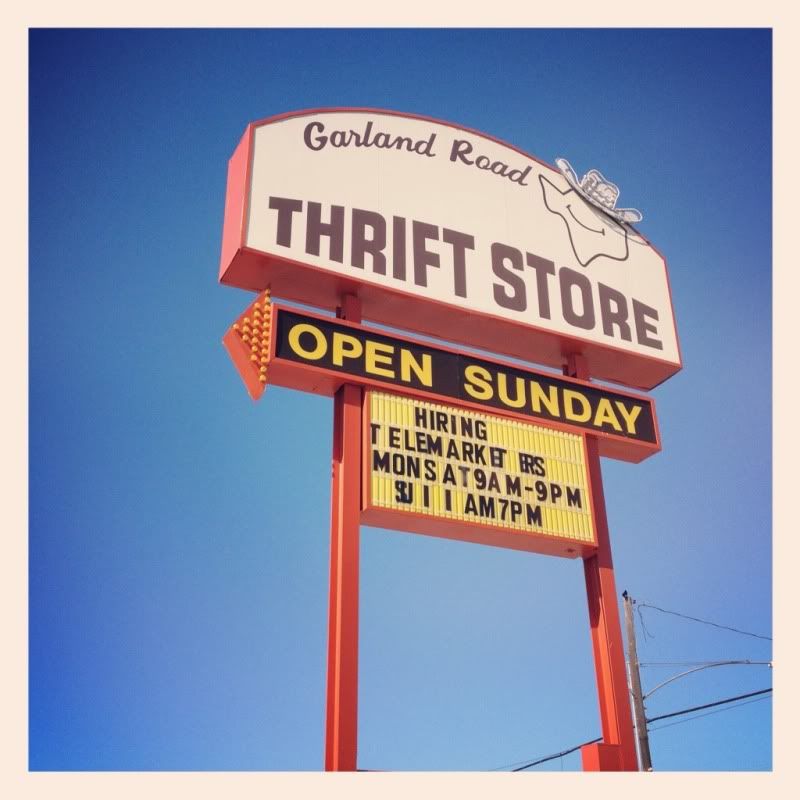
Garland Road Thrift: 10030 Garland Road Garland 75040 - Highly recommended among Dallas thrifters. Prices are slightly higher than Goodwill's, but you'll find new merchandise from J Crew and Loft among vintage pieces. Don't miss the evening wear section.

Texas Thrift: 1406 W Walnut Street Garland 75040 - The largest in the state!
Thrift City: 1725 S. 1st Street Garland 75040
Salvation Army 1905 S Garland Ave Garland, TX 75040

Dallas:

Salvation Army: 5554 Harry Hines Blvd. Dallas 75235 - Don't miss the special room in the back. I've bought most of my Ferragamos here!

Dolly Python: 1916 North Haskell Dallas 75204 - A fantastic indoor flea market/antique mall/thrift store

Value World: 2223 S. Buckner Blvd. Dallas - Somewhat scary neighborhood, great vintage. No dressing rooms.

St. Vincent de Paul Thrift: 3052 W. Northwest Highway Dallas 75220 - Look for new Michael Kors and Fossil watches. Many Dallas socialites donate to this store.

Buffalo Exchange: 3424 Greenville Avenue  Dallas 75206
Thrift World:  3046 Forest Lane Dallas 75234 No dressing rooms.
Lulu B's Antique Mall:  2639 Main Street Dallas 75226
Goodwill Westmoreland Avenue location: 3020 North Westmoreland Road  Dallas, TX 75212

North of Dallas:

The Thrift Store Plano: 1806 K Avenue Plano 75074 - My favorite thrift store in all of Dallas. I've found Armani, Bruno Magli, Coach, Ungaro, and Victor Costa here at unbelievable prices, along with brand new merchandise from J Crew, the Gap, and Anthropologie. No dressing rooms.

Plaza Thrift: 817 North McDonald McKinney 75069 - Recommended to me by a blogger friend, this store is similar to The Thrift Store. No dressing rooms.

Goodwill Carrollton: 18230 Midway Road Carrollton 75287
Salvation Army Plano: 5900 K Avenue Plano 75074
Goodwill Alma location: 6104 Alma Drive  Plano 75023
Goodwill McKinney: 2010 North Graves Street 75069

Lewisville:

Thrift World: 1358 W. Main Street Lewisville 75067
Thrift City: 1565 W. Main Street Lewisville 75067
Goodwill: 919 W. Main Street Lewisville 75067

Feel like taking a road trip? The town of Sherman is quaint, filled with antique malls, and has some excellent thrifting to boot!

Sherman:

Goodwill Texoma Parkway location:  1836 Texoma Parkway Sherman - 75090 One of the largest Goodwill locations I've ever visited!

Goodwill Lamar St. location: 2206 East Lamar Street Sherman 75090 - Situated next door to the Goodwill Last Call processing center, where you can find appliances, home decor and odds and ends at prices even lower than those at Goodwill retail locations.

Salvation Army:  426 W Houston St. Sherman 75090

Also...if you're looking for higher end vintage, you should DEFINITELY check out:

Vintage Martini: 1106 W. Main Street Carrollton 75006 Voted best vintage store in Dallas multiple years in a row. Fantastic customer service.

Decades Vintage: 2912 Maple Ave Dallas 75201

Thursday, April 26, 2012

Join me on Saturday at Vintage Martini!


I'm thrilled to invite all of you to the celebration and signing of my book, Thrifting 101: A Beginner's Guide to Thrifting and Vintage, this Saturday at Vintage Martini in Carrollton, TX! Vintage Martini has been voted the number one vintage store in the Dallas/Fort Worth area multiple years in a row, and features some of the most amazing pieces to be found in the country - things like Chanel jewelry, Prada pumps, 1920's flapper dresses and extravagant 1950's ball gowns. It's my favorite place in all of the city, and I'm so flattered to host my book signing there.

Vintage Martini is located at 1106 West Main Street in Carrollton, 75006. The signing is from eleven to two pm. Can't make it? You can still support me by purchasing a copy of my book - just click on the image above!

Thursday, April 19, 2012

Thrifting 101: Have you ever felt thrifting shame?


"I love those heels! Where'd you get them?"
"Your vintage dress is so pretty! How can I get one?"
I would kill for those jeans."
Loving your southwestern shirt."

Thrifting used to be a secret, covert activity executed primarily out of necessity. Once upon a time, back in the dark ages when I was a geeky and awkward high school student growing up on Long Island, there was a certain amount of shame and embarrassment about thrifting. It wasn't popular. It wasn't trendy. It wasn't something people wrote blogs about or bragged about or boasted over. No, you thrifted out of necessity, because you were broke or cheap or just wanted to avoid wearing mall clothes like your peers did.

Things are quite different today. The negative qualities associated with thrifting have largely disappeared, and it's more common for thrifters to gloat about their scores than feel shameful about them. Thrifting has become so popular that Goodwill Industries International Inc., opened more than 180 new or relocated stores in 2010. In addition, total retail store sales increased 10 percent compared to 2009.

But I wonder if the discomfort and shame about having to thrift still exists. In certain parts of my own city, the idea of digging through bins at the Goodwill is distasteful to some. And there might be thrifters who purposely avoid revealing to friends and family that the clothes they wear are largely thrifted.

So I ask you: Do you tell people that you thrift? When complimented on an item you're wearing, are you likely to share that it was thrifted? Have you ever felt shame about thrifting?

Thursday, April 12, 2012

Thrifting 101: Shop talk with Amy of Haberdash and The Swapaholics

A few weeks ago, I talked about starting a sub-series within my Thrifting 101 Thursday posts focusing on vintage stores, online shops and businesses that specialize in selling vintage apparel, leather goods, and pieces created from secondhand or recycled materials. The response was so positive that I've decided to flush out the sub-series fully and continue interviewing shop owners.

Today I bring you an interview with Amy (a.k.a Punky), owner of the mobile vintage shop Haberdash and creator of The Swapaholics. Amy is a powerhouse - a smart, savvy businesswoman with a strong commitment to secondhand style and community. In addition, she's one of the most lovely and genuine women I have ever met. Read through and get to know Amy and Haberdash better!


Tell us a little bit about yourself. Where are you from? What’s your background?

Hmm…Let’s see, I’m a style blogger, dog mom, and a super nerd. I grew up outside of Boston, went to school for Interior Design and then Psychology. I got bored with both and decided to open my own business or businesses rather: Haberdash and The Swapaholics.

How did you first get introduced to thrifting?

I come from a long line of antique collectors, so my childhood was spend at yard sales, estate sales and Antique shops. But the first time I remember thrifting was in high school around prom time, I was so paranoid that someone was going to show up wearing the same dress as me. I had a huge issue with blending in.

When did you really become passionate about buying and wearing vintage clothing and accessories?

I think it was around that same time in high school. I remember finding this vintage lace slip dress that I wore religiously through high school and college, it was so different from all the American Eagle that was plastering the halls. I was hooked.

What inspired you to start Haberdash?


I started Haberdash Mobile Vintage Shop in February 2009. I had been selling vintage clothing online since 2005 and the stock was overflowing out of my house. At the time I was looking for a brick and mortar space, but I wasn’t falling in love with any place. I grew up around classic cars and trailers, so once I had the idea, I knew exactly which trailer I wanted (some extremely rare model, of course!)

You have a very active social media presence (including amazing Pinterest boards!) How has social media helped you grow your business and reach other vintage enthusiasts?

Aww, thank you! I love to inspire everyone to embrace their own personal style. So I post a lot of photos of things I find unique or one-of-a-kind and it has connected me to so many like-minded people. (Find Amy on Pinterest at http://pinterest.com/Punkystyle/)

Any current projects you’re working on?

I am again on the hunt for a brick and mortar shop or second truck to house all the mobile shop overstock. But, The Mobile Shop is sticking around.

Do you have any helpful hints for those new to buying vintage?

I think the best thing to do when you are new to vintage is visit the upscale vintage shops first and get a feel for the decades and fabrics. The people that run these shops are a wealth of knowledge and they love to dress people. Sure, you can find vintage cheaper at a thrift shop, but if you don’t know what to look for it can be discouraging.

Follow Amy on Twitter at @PunkyStyle, the Haberdash at @TheHaberdash, and the Swapaholics at @TheSwapaholics. 

Thursday, April 5, 2012

Thrifting 101: How to identify counterfeit handbags at the thrift store

On Monday I went thrifting, and I came across this:


Discovering a high-end designer bag is a thrift score even the most adverse to thrifting would celebrate. For seventeen bucks, this huge vintage Gucci tote seemed almost too good to be true. I gave it my usual once-over in the store, checking for frayed stitching, tears, funky odors and stains. It was clean - and even came with its original control tag. All my years of thrifting had paid off. I had located my thrifting holy grail.

Or so I thought. On the way home, I was nagged by the thought that the bag might be fake. After all, who in their right mind would donate a near-perfect vintage Gucci tote? Had I just wasted seventeen dollars that could have gone to better use? Though I carried it on my arm the very next day, I couldn't shake the feeling that I might have been swindled.

According to the International Chamber of Commerce, counterfeiting makes up five to seven percent of global trade, or $450 to $500 billion. Buying counterfeit merchandise helps keep sweatshops and child labor in third world countries in business. While any name brand is at risk for counterfeiting, the most commonly ripped-off labels include Louis Vuitton, Kate Spade, Christian Dior, Prada, Gucci and Burberry.

So, how can you tell the difference? Experts say it’s the small details that are often overlooked by manufacturers of designer knockoffs. All you need to do is take the time to pick apart the fakes to reveal their many flaws. Here are some tips for identifying and avoiding counterfeit bags at the thrift store.

Understand the difference between an illegal fake bag, a designer-inspired bag, and the genuine article:
  • Illegal fake bags make every attempt to copy a genuine designer bag, right down to the very last logo, tag, and hardware. Fakes copy everything about the designer bag, and pass themselves off as the original brand, with no attempt to distinguish themselves as look-alikes. It's illegal to make fake merchandise, and while buying it is not illegal in most countries, doing so supports illegal activity.
  • A legal knock-off/imitation is "designer-inspired" but is not a direct copy. Such a bag does not claim to be the original designer's bag and does not attempt to use the trademarked symbols, logos, or features, and as such can legally imitate the style and colors of a bag while avoiding breaching copyright. Without close inspection, it can be easy to mistake a legal knock-off for the real thing.
  • A genuine designer bag is made by the original well-known designer and the bag's logo, hardware, attachments, etc., are all congruent with the original design - down to the exact positioning and number of such features. Tags, signatures, or marks stating the designer's name form an integral part of the bag's overall design and authenticity.

Know the signs of a fake knock-off bag:

There are numerous signs that can point to a bag's lack of authenticity:

  • Stitching: Look closely at the stitching of the bag. Sloppy, slanted, and uneven stitching is a sign of a poorly made, and therefore, fake bag. Some knockoffs do take the time to stitch the lining into place; in these, look for threading that is pulling in spots. A real designer bag would have near-perfect threading. Designer bags will always have quality stitching because it is part of the designer's reputation to produce a quality item.
  • Tags or labels: Check the inside tags – are they stamped into leather or hand-stitched? An obvious fake will have no name on the inside tag. Check outside tags as well because many designers include authenticity labels on the outside of the bag.
  • Material: If it's leather, it should smell like leather. If it's supposed to be durable canvas, it should be strong and well stitched. The material can communicate a lot about the bag's quality. If the real bag normally has a pattern inside, fake bags typically will not. Often, the lining inside a fake bag feels cheap and thin.
  • Logo: Logos are often a slip-up area for copies. The designer name might be spelled slightly differently, such as Carter instead of Cartier. A logo embedded into a pattern, such as Louis Vuitton's alternating "LV" design, should be continued throughout the bag without interruption. 
  • Hardware:  It’s difficult for counterfeits to exactly duplicate the hardware design of authentic items. For example, authentic Gucci Horsebit bags will have complete closed connecting rings while counterfeits will have a break in the rings.
  • Serial number: Some high-end designer bags have serial numbers on a tag or stamp inside the bag. An authentic Gucci bag, for example, has a brass plaque inside the purse that says Gucci Made in Italy on a leather tag with the serial number embossed underneath.
  • Handles: Genuine Louis Vuitton handles are made of an entire strip of natural leather. When first purchased, the handle is light tan in color; over the course of a few weeks, it should oxidize and turn into a darker, cognac color. Fake bags don’t change color like this because the handles are usually painted.
  • Do your research: If a Coach bag has a leather strip down the middle, the strip should say "Leatherwear." If it doesn't, it's a knock-off. Louis Vuitton purse snaps are monogrammed, as are those from Gucci. Knowing where a bag is made helps as well. Coach bags are made in China, not the United States.
Wondering about my own thrifted Gucci bag? After some research I made the discovery that my bag is real! How do I know?

Gucci bag

My Gucci bag is made from heavyweight vinyl-coated canvas that feels substantial. The stitching is even and straight. Solid brass logo hardware is present, as well as a rounded interior tag (knockoff Gucci bags have a rectangular or square tag with sharp corners.) An authentic vintage Gucci also has a brass plaque inside the purse that says Gucci Made in Italy - it will be on a leather tag with the serial number embossed underneath, just as mine has. Furthermore, the serial numbers on my bag correspond to those present on a vintage Gucci bag. Serial numbers on vintage Gucci bags almost always start with a 0, 1 or 2. Ninety-nine percent of NEWER authentic Gucci bags do not start with these numbers. If you see a Gucci bag in a style from a recent collection with serial numbers that start with 0, 1 or 2, the bag is fake.

Have you ever bought a designer bag at a thrift store?

Thursday, March 29, 2012

Thrifting 101: Do you thrift and tell?


We all have our secrets.

We might take credit for a recipe that came from Paula Dean. We may dye our hair in the bathroom sink and claim its gorgeously glossy color as our own. On occasion, we pretend to love the National Geographic channel when we'd much rather curl up with Mob Wives. There are those who swear allegiance to their spouse's favorite football team but really, really, really hate football. And let's not forget the plethora of secrets we keep from nosy neighbors and suffocating in-laws. Those are better left to ourselves.

Amongst thrifters, there's a different kind of secret. It's the hushed voice, the inquisitive glance, the pinkie swear that what is spoken will not be shared. This is the kind of secret many thrifters keep from their best friends and closest relatives -- the most guarded information which they squirrel away in the dark, twisty recesses of their brains.

It's the name of our favorite stores.

I was at a blogging event last spring when I found myself chatting with a fellow thrifting enthusiast. She was wearing the most incredible vintage skirt, and I asked her where she got it. "I'd rather not say," she stated, eyes cutting left and right. "It's my favorite thrift store. You understand." I spent a good fifteen minutes trying to pry the name of the store from her before giving up. I was so baffled by this incident that I wondered if I was committing a grave error by freely sharing the names of my own favorite stores. Would I benefit by refusing to share the stores I shopped at the most? Was I breaking some sort of cardinal rule by inquiring about where acquaintances thrift? Are we thrifters expected to keep our favorite shops a secret?

Since I started my Thrifting 101 series a year ago, I've received a countless number of emails from those both in and outside of Dallas asking where I thrift. I would never consider keeping the names of my favorite stores a secret. Why? First of all, I love being part of the thrifting community. I love sharing my scores with friends, and discussing the best way to remove stains from silk (Oxy Clean Max Force gel stain stick and a gentle spin in the wash...trust me). I love planning group thrifting excursions, and I adore celebrating the special pieces my friends dig up. Part of the joy of being a thrifter is sharing the excitement of a treasured find with a like-minded enthusiast -- someone who loves thrifting and vintage as much as you do. There is a real sense of community among thrifters, and I'm proud to be a part of it.

Secondly, we when thrift, we are all looking for different things and in different sizes. My preference for sequins and 1950's dresses with full skirts might not be yours. Your budget might not be the same as mine either, and our reasons for thrifting could be dramatically different. As a result, we could  thrift at the same store and have totally conflicting experiences. Purposely choosing not to share favorite stores transforms a treasure hunt into a competition. And why would we want to do that? There's more than enough thrift fun to go around.

Now I ask you: Do you share the names of your favorite haunts, or keep them to yourselves? Has anyone ever refused to share their best stores with you? Do you keep thrifting secrets?

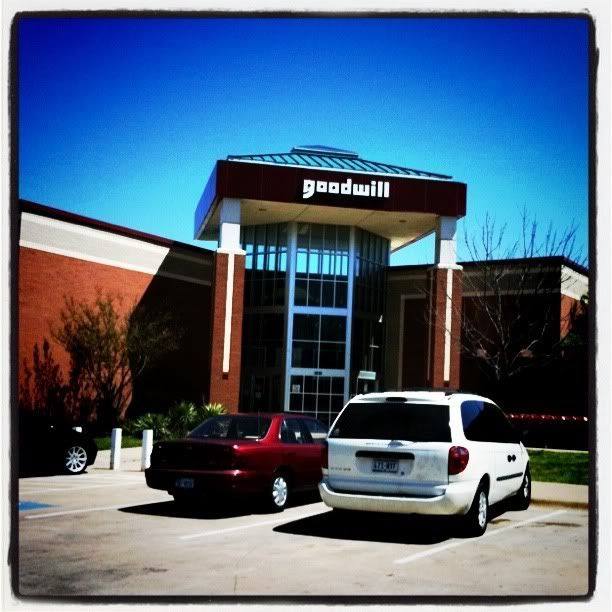
(P.S: Curious about the ginormous Goodwill pictured above? It's located at 2010 North Graves Street in McKinney, Texas and is one of my favorites!)

Thursday, March 22, 2012

Thrifting 101: Shop Talk with Pocketful of Pearls

At the Texas Style Council Conference, I was privileged to speak with three other bloggers on creative consumerism. To be honest, I wasn't entirely sure what the term creative consumerism meant. I concluded that it's a philosophy defined by responsible shopping with a nod towards eco-awareness. As I was preparing for the panel, I realized that I could be making much more of an effort to be a responsible consumer. Though my wardrobe is approximately 90% thrifted, I don't pay nearly enough attention to supporting local small businesses. And while my clothes are overwhelmingly secondhand, I am largely uneducated about the impact clothing overproduction, specifically in the "fast fashion" category, has on our environment (a topic I hope to explore in next week's Thrifting 101 post.)

With this in mind, I'm introducing a new feature within my Thrifting 101 series called Shop Talk. I'd like to highlight small businesses that specialize in vintage clothing and accessories, whether based in my local community or on Etsy. If you have a vintage store, or online shop or business that specializes in creating apparel, leather goods or jewelry from secondhand or recycled materials, please contact me - I'd love to feature you and your business!

To kick of Shop Talk, I'd like you to meet a Dallas vintage enthusiast named Michelle, owner of  Pocketful of Pearls. I first met Michelle at the Dallas Flea and was immediately struck by both her amazing personal style and well-curated shop. Pocketful of Pearls has been featured in D Magazine and specializes in offering a wide range of sizes, which is an unusual and welcome feature in a vintage store. Read along and get to know Michelle and her wonderful shop better!


Tell us a little bit about yourself. Where are you from? What’s your background?

My name is Michelle Parker and I was born and reared in Arlington, Texas but my cultural/ancestral heritage is of Sierra Leonean decent (West Africa). In 2003, I moved to Dallas to attend Southern Methodist University and have lived here since I graduated. I would describe my personal style as evolving. I like to dress according to my mood that day and I try to incorporate at least one statement piece. I also enjoy mixing vintage and retro pieces, similar to what you will find in my store.

How did you first get introduced to thrifting?

I was first introduced to thrifting in college. I became obsessed with the idea of finding quality, eye-catching clothing and accessories at a fraction of the cost.

When did you become passionate about buying and wearing vintage clothing and accessories?

I've always had an interest in clothing and accessories from different era's but my passion advanced when I began to develop my own personal style. I love the fact that when you shop vintage, you know you are getting a limited, if not one of a kind, item. I also enjoy the thrill of the hunt! I can walk into a store with no expectations and, with a little patience, walk out with a beautiful Victor Costa jacket or a signed Miriam Haskell necklace.

What inspired you to start Pocketful of Pearls?

P.o.P. developed from the excitement of “treasure hunting” and the premise of standing out while saving money. Through conversations, I realized there are lots of people that have this same interest, however they do not have the time or patience. As an online shopper myself, I also felt like there was a void with vintage/retro online boutiques that also carried a full range of sizes.

The P.o.P closet is all about variety and personality. I wanted to create a place for people who want to add eye-catching pieces to their wardrobe and aren't afraid to step out of the box. When you visit the site, you will find an eclectic mix of handpicked vintage and retro. Expect to explore a new way of shopping that is based on your current mood or the mood you would like to convey.

Any current projects you’re working on?

Yes! I’m so excited to be a part of Dallas Flea again on April 21 which is a fun shopping event showcasing several Texas vendors. I will also be a part of a pop-up shopping event hosted by Chastity from The Curvy Girl's Guide to Style in May. The easiest way to find out about future P.o.P events and exclusives is through our Facebook page (Facebook.com/pocketfulofpearls).

Do you have any helpful hints for those new to thrifting and buying vintage?

If you find one or two favorite thrift stores, find out about their sale days. Some stores have entire days where their inventory is 75% off. Also if you if you have a flexible work schedule, weekdays are a great time to stop by these stores. Most importantly, have fun! Try getting out of your comfort zone and explore new options.

How would you describe thrifting in Dallas? Do you prefer thrifting in smaller charity shops or larger, more corporate-based stores?

Expanding it to DFW, I would say “lots of options”. The good (and sometimes bad) thing about Dallas is that we are so spread out. Thrifting has definitely become more popular in the recent years, however because Dallas has so many options, you still have that feeling of thrill for the hunt. I personally prefer shopping at small charity shops because I like supporting non-profit organizations doing good work.

Thursday, March 15, 2012

Thrifting 101: Thrift tips for the busy shopper.


{Source: Stephanie from Those Tricks}

It's just after five-thirty on a Tuesday afternoon. You've packed up your things and left work (or school.) Your head is spinning with all of the tasks you need to complete - mundane, ordinary things, like picking up milk from the market and stopping to get gas and swinging by the dry cleaner to fetch your favorite pink dress that you accidentally spilled chocolate syrup on. There's also the pile of work you brought home and your boyfriend/husband/cats that demand your attention. Earlier in the day you had thought about going thrifting, but now you're worried there might not be enough time. Thrift stores are huge, you sigh. How on earth can you dig up a great find when your stay there will be so limited?  Wearily, you conclude that thrifting is just not for you.

You could not be more wrong.

It's true that the more time you spend in a thrift store, the better your chances are of making a big score. A leisurely hour (or two) of thrifting permits you to explore every little corner, from shoes to housewares to men's tee shirts and books. But you'd be surprised how much you can accomplish in a limited amount of time.

Here are some tips for negotiating thrift stores with time constraints:

  • Plan thrifting pit stops: If you have a busy schedule, try to find gaps in your day when you can stop in and quickly browse on your way to your next destination. Many thrifters find it helpful to map out all thrift stores within a 50 mile radius of their homes or work. Luckily, there's a free iPhone app called Thrift Buddy that can help you out. It locates over 10,000 thrift stores in the United States and also includes store hours.
  • Be efficient: Before you enter a store, think about what you're looking to thrift and tailor your time around that goal. For example, with the arrival of spring I'm most interested in thrifting for spring and summer dresses. If I'm on a time crunch while thrifting, I make sure to immediately head for that section. I don't allow myself to get distracted by the blouses, or blazers, or anything shiny (which is a problem because I'm a magpie for sequins and evening wear.) I seek out the dresses and that's it.
  • Dress accordingly: I've noticed that I tend to lose most of my time in thrift stores while in dressing rooms. Taking off blouses with tiny buttons, or multiple layers, or tights layered with socks eats up minutes as I'm rushing to try things on. Wearing something that's easy to slip on and off, or slip clothes over, will cut your time down significantly.
  • Set an alarm: Really stressed for time? Set an alarm on your phone as soon as you enter a store. Be sure to leave yourself an extra five minutes for check out. If you haven't found anything when your time is up, don't stress! It's better to leave empty handed than spend money on something you don't really need.
Do you have any tips for busy thrifters? Do you avoid thrifting altogether because you're worried you won't have enough time?

Tuesday, March 6, 2012

Buy my book, Thrifting 101: A Beginner's Guide to Thrifting and Vintage

bookbutton

I'm extremely proud to announce that my book, Thrifting 101: A Beginner's Guide to Thrifting and Vintage, is available for purchase! Writing this book has been a lifelong dream, and I am simply thrilled that it's finished.

I must mention that Thrifting 101 would not have been possible without the support of you, my friends and readers. By reading my posts on thrifting every week, following up with comments, and emailing me questions, you've given me the courage to publish. Thank you so much for your support and encouragement.

Some highlights of Thrifting 101 are:
  • A comprehensive guide to fashion history from 1920-1990,
  • cleaning tips.
  • styling advice,
  • and insider tips on navigating thrift stores.

If you'd like to buy a copy of your own, simply click on the book image and it'll take you to checkout. If you're interested in doing a review for your own blog, please leave a comment with your email address and I'll get in touch with you. I'll also have copies for sale at the Texas Style Council Conference this weekend.

To celebrate the publication of Thrifting 101, I'm offering a special giveaway: One lucky winner will win a copy of your own along with a surprise vintage gift! Just leave a comment and you're entered to win.

Thursday, February 23, 2012

Thrifting 101: An interview with Pamela of Market Publique, the online vintage marketplace

Among my many duties as community outreach manager and social media kingpin (ha, ha) for the Texas Style Council Conference is creating content for the TxSC blog. So along with writing posts for Dress With Courage, I've been posting for that blog as well. It's no wonder I've been so busy!

I had the privilege of interviewing Pamela, founder of  Market Publique, for the TxSC blog, and I've decided to include the interview here as part of my Thrifting 101 series. I was fortunate to meet Pamela in New York City this past fall, and trust me when I tell you that few people are as knowledgeable about thrifting and vintage as she is. As founder of Market Publique, the online marketplace for vintage clothing and accessories, Pamela is smart, stylish, and incredibly down to earth.

Read through for my interview with Pamela, and get to know her and Market Publique!

Pamela

Elissa: Tell us a little bit about yourself. Where are you from? How long have you been in NYC? What’s your background?

Pamela: I was born and raised in Guatemala City and moved to New York to go to Parsons School of Design. I loved it so much I stayed and I have lived here for almost 8 years. My background is in design, fine art and business. Most of my experience is with User Experience and Interaction Design and Product Development -- which means I analyze and anticipate how people will use a website and design features to solve their problems or make their interactions easier. Before, I used to design and develop marketing & advertising campaigns for clients like Estée Lauder, InStyle Magazine, The New Museum and others.

E: How did you first get introduced to thrifting?

P: When I was younger, my family and I traveled to Florida for the holidays almost every year. My grandmother and dad love thrift stores and garage sales and I would often tag along. While they were busy with the housewares, I would browse through the jewelry and clothes and realized I could get similar styles to what I could get at the mall but at much lower prices -- and reduce the risk of showing up to school in the same dress as someone else! When you are a teenager on an allowance that’s huge!

E: When did you become passionate about buying and wearing vintage clothing and accessories?

P: Once my grandma realized that I loved older things, she started giving me things from her closet -- a necklace, a belt, a handbag here and there. I loved them and and they became my favorite and most-worn things. My mom also gave me all her Gucci bags from the 70s and 80s. Later on I started collecting my own vintage and found that a lot of times it fit better than new clothes. There’s nothing like a 50s dress for me - - the fit is just right and the fabrics are way better than what you can get for similar prices. I also collect vintage jewelry, as it never goes out of style and is unique and statement-making.

E: What is the best thing you’ve ever thrifted? What’s the most cherished piece in your closet today?

P: The most treasured things in my closet by far are always what has been passed down to me. My great-grandmother’s Guatemalan chachal, my mom’s 70s Gucci purses and belts, my grandma’s jade necklace and turquoise and pearl pins...

The best things I’ve ever thrifted are surprisingly not clothing! I found a replica Arco lamp and a Wassily chair at Housing Works Thrift shop. I got an amazing deal on both pieces, especially because the lamp needed to be rewired - which is not that much! If you buy the original ones new at Design Within Reach they would have cost me over $5,000!

E: What inspired you to start Market Publique?

Markey Publique homepage

P: I had been selling vintage on the site on eBay and then, after all the changes to their policies, feedback system and fees, I switched for a while to Etsy, but found that neither of them had the right tools to sell vintage online. It takes a really long time to list an item for sale on eBay and at the end of it it doesn’t look all that and they hit you with a ton of fees. On Etsy I felt that you couldn’t really brand your shop and make it stand out and portray your style.

I looked for other alternatives but realized there was nothing out there for vintage specifically. Since I have a background in building web-based products, I decided to do something about it and build it! We are the only community exclusively for vintage, so we have become a destination for buyers looking for fashionable vintage. Our tools, taxonomy and listing process is designed specifically for vintage, making it easier & quicker to list than on Ebay or Etsy, and easier to shop as well.

We curate the sellers, which are either invited or go through an application process, to ensure that everyone is in good company and the quality of vintage and photography on the site stays high. This is very important to both sellers and buyers because it elevates vintage as a whole. When you have people selling items photographed on the carpet or on a scary mannequin with an unbrushed wig, it perpetuates the stigma some people have of vintage being 'old clothes' or not fashionable. Our site is for great quality, stylish vintage that can integrate seamlessly into your everyday wardrobe.

We also advertise and are present in many other fashion communities like Chictopia, Lookbook.nu, Fashism and more, and work with bloggers to inspire people to wear vintage in modern ways and show them how to mix it in with their new items.

E: How does Market Publique work?

P: We curate sellers & boutiques from around the world, who are either invited or go through an application process (if you are a seller or boutique you can find more information here and apply here. Each seller uploads their item listings complete with photos, descriptions, measurements and price, including how much the shipping on that item is.

As a buyer, you can register or log in to purchase an item outright or place a bid, depending on the listing. You pay the seller for the item directly via PayPal, and the seller ships the item to you. You can then rate your experience by leaving feedback. We charge the seller a small listing fee ($0.25), plus a small percentage commission (5%) once the item sells.

E: What are the advantages of buying vintage on Market Publique, as opposed to eBay?

P: Because our site is exclusively for vintage, there’s no guesswork into whether or not an item is really vintage and a lot less searching and sifting through an overwhelming amount of mis-categorized listings or vintage knockoffs. There’s also a lot more trust in our community, as the sellers are vetted and curated by us. They provide high-quality vintage items with great photos, so you can see what the item looks like really well. They also describe their items honestly and accurately and provide excellent customer service. It’s more like shopping in a curated vintage boutique than digging through piles at the Goodwill outlet, and the prices are still reasonable because the sellers don’t have to deal with the extra costs of renting a store front.

E: Any current projects you’re working on?

P: There’s many projects we’re working on! We just launched a collection of archival Cadoro pieces in collaboration with The Greedy Seagull. These pieces are highly collectible and very rare, so we’re proud to be hosting them on our site. We’re also revamping the whole site, so stay tuned for our new face-lift - and relaunching curated themed collections with The Vintage Coalition, an invite-only group of the best vintage sellers on the web.

E: Do you have any helpful hints for those new to thrifting and buying vintage?

P: Start with accessories if you’re really new. It’s a lot easier to add a necklace or a clutch to an outfit and get warmed up to all the compliments! Also, make friends with your tailor. You can turn a good piece into a show-stopper with a few minor, inexpensive alterations. Hemming, for example, is an easy way to make a vintage dress look more modern. Just make sure you don’t hack off a huge chunk off a 40s designer dress!

Thursday, February 16, 2012

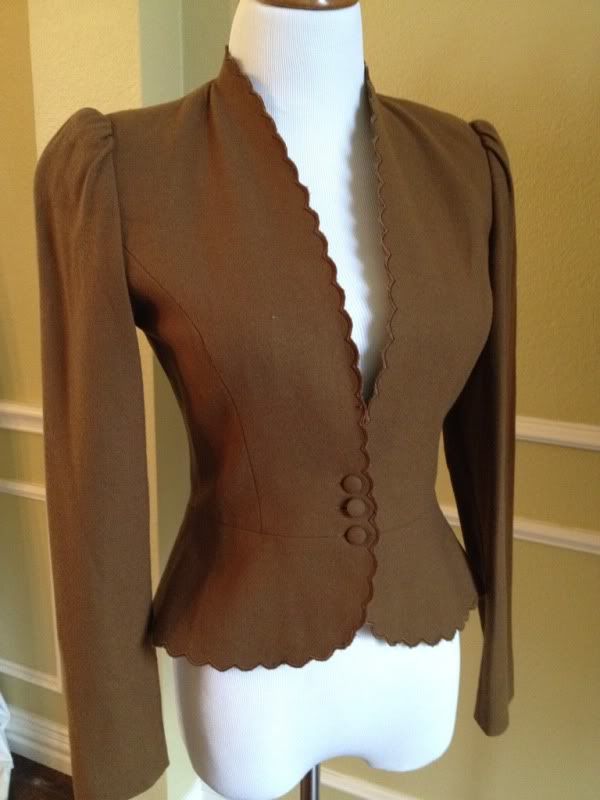
Thrifting 101: Thrifting The Trend - The Peplum


Popping up everywhere from New York to Paris, spring 2012 collections included a large, unmistakably flirty ruffle on silhouettes ranging from skirts and jackets, to dresses and blouses. This feminine note is the peplum. The February 2012 issue of Elle identifies the peplum as one of the four key silhouettes of spring 2012 (the others being the boxy jacket, pleats, and the maxiskirt). Long associated with 1950's ladylike fashion and 1980's excess, peplums are a fun nod to the past and can be extremely flattering to a woman's figure. Even better, they're often noticed while thrifting. So what's all the fuss about peplums? Today, we'll find out.


The peplum, a term dating back to the 19th century, is a short overskirt that is usually attached to a fitted jacket.  However, earliest versions were typically not attached to a jacket, but functioned merely as an extra overskirt or flounce dropping from the waist. The modern peplum, as we now know it, became popular as a design in women’s suiting in the 1940s. Here it took on its most recognizable form. Suit jackets were often fitted at the waist, but fabric extended beyond the waist in an overskirt. Women wore peplum-appended coats and dresses as a way to draw attention to a tiny waist and hourglass figure -- without being overtly erotic

McCall's dress pattern, c. 1940's

Sometimes the peplum was deliberately flared, enhancing or suggesting greater curve to the hips. In other styles, the peplum fit closer to the stomach and the hips, emphasizing the tight waist of the garment. A flared peplum with a skirt that also flared was common, as was a peplum with a pencil skirts.

The peplum fashion faded in the 1950s but came back with a vengeance in the late 1980s and early 1990s. This was part a reaction to the boxy menswear-style jackets with exaggerated shoulder pads that were popular during the mid-1980s. Most jackets with peplums in the late 1980s still had shoulder pads, but feminine curves were emphasized by a fitted waist and either a flounced or straight peplum, usually covering the hips and stomach.


The right peplum can accentuate boyish hips, create the illusion of a smaller waist and mask less-than-flat tummies. Peplums are flattering on many women in that they add curves on a slender form with narrow hips, and, at the same time, accommodate generous hips and disguise them while highlighting the waist.

Examples of thrifted peplums

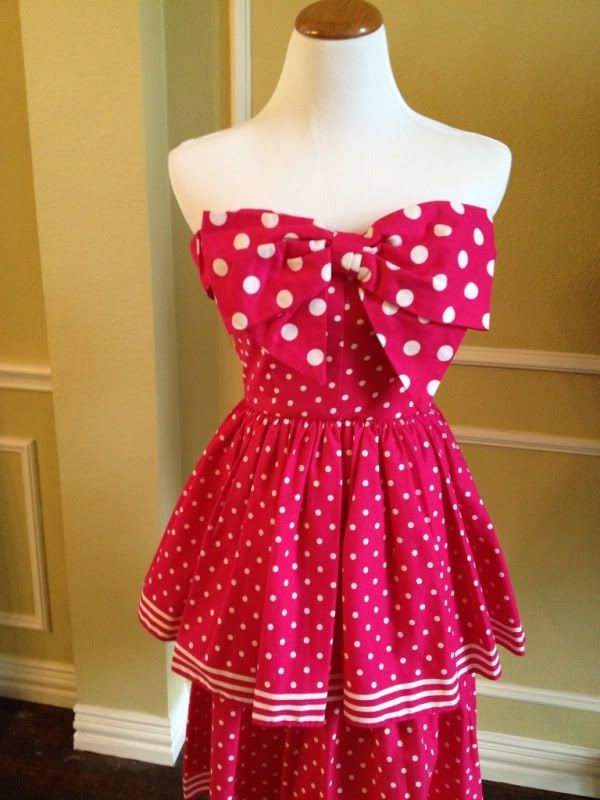
Victor Costa polka-dot dress, c. 1980's

Vintage blazer, c. 1940's

When searching for peplums while thrifting, head first to the dresses, skirts, and blazers section of your favorite store. Eighties dresses with peplums are aplenty, often in loud floral or abstract prints. If a peplum silhouette makes you shy, consider a dark, monochromatic style - a black, brown, or navy blazer with a slim dark pant or pencil skirt. Peplum blouses can also be thrifted. Pairing a peplum top with cigarette pants can offset the top's girlishness and balance it's volume.

Would you wear a peplum? Have you had luck thrifting for silhouettes featuring them?

Wednesday, February 15, 2012

Coming soon...


If you've been reading my blog for awhile, you've likely heard me mention a little book I've been working on. Well, today the final proof came in, and I'm proud to introduce Thrifting 101: A Beginner's Guide to Thrifting and Vintage to you! I'm going to offer it as both an ebook and a hardback edition. More details regarding price and ordering information will be forthcoming in the next two weeks.

On a related note...this book would not have been possible without the support I've received from you, my followers and readers. THANK YOU for encouraging me as I've shared my love of thrifting and vintage with you. Thank you for dropping by each day, and leaving comments, and sending me emails, and allowing my blog to be a part of your life.

Thursday, February 9, 2012

Thrifting 101: My thrift story. What's yours?

There once was a girl.


She lived with her mom, dad, and little brother in an apartment in Queens, NY. Money was tight, so they lived very frugally. Sometimes they went on food stamps. But the girl didn't mind. She always had nice things to wear, and friends to play with, and family who loved her.

This girl eventually grew up, and became a teenager...


...who left middle school, went to a performing arts high school in Manhattan, and discovered thrift stores.


Thrifting was her passion. It was also her secret. You see, when she was growing up, thrifting wasn't something you bragged about (or blogged about.) Thrifting was an activity you did strictly out of necessity. Going to a thrift store was shameful and embarrassing - an admission of financial desperation. To visit a thrift store not only meant you were too poor for the mall, but also that you were perfectly fine wearing someone else's used clothes. These were two things teenagers generally frowned about in the nineties. So this girl kept her after-school activity hidden.

She thrifted throughout high school and college, learning how to identify vintage, when the best days to thrift were, and where the best stores could be found. She thrifted for vintage Levis, and concert tees, and leather belts, and wool plaid skirts, and seventies men's suede jackets. Thrifting was both a way for her to develop her personal sense of style and stretch her dollar. And it was fun.

Eventually, though, this girl grew up. She got married and moved to the Texas suburbs and had a few kids. She forgot about thrifting, and started buying her clothes at the mall. But something was missing. She found herself wistful for those afternoons she spent at the Goodwill. She tenderly remembered the thrill she'd had after digging out something wonderful from a thrift store rack. So she returned to the thrift stores, and hasn't looked back since.

Blazer? Blouse? Pants? Shoes? Thrifted.

It's hard to believe that I've been thrifting for twenty-five years. I've battled against allergies, staples impaled into my thumb (why thrift store insist on stapling price tags into clothes, I'll never know), creepy men trying to hit on me, other shoppers attempting to steal things out of my cart. There have been highs - such as the Christan Dior sweater I thrifted for $3 a few weeks ago - and lows. Blessedly, the lows are few and far between. I am addicted to the thrill of the unknown, the possibilities that exist when I enter a thrift store, and the knowledge that I'm saving hundreds of dollars a year on clothes for both myself and my family.

So what's your thrift story? When did you get started thrifting? What first brought you into a thrift store?

Thursday, February 2, 2012

Thrifting 101: What I Thrift For

Allow me, for a moment, to share what I did last week.

On Monday I went thrifting. On Tuesday I went thrifting. On Wednesday and Thursday and Friday I went thrifting. Thrifting is magic, I think. There's something about the thrill of the hunt, buying things I wouldn't normally be able to afford, and coming home with a bag filled with vintage treasures for less than $20. I love perusing the racks, sifting and digging and excavating. And then, in the middle of polyester blazers and pleated pants and oversize sweaters, it happens. A gem is found.

sequins

Though my thrifting goals change with the seasons, there are some designers and items that remain perennial favorites. These are things I look for every single time I hit a thrift store.

Sequins

red sequins

I am not a glamorous eighties soap star. Nor am I a socialite in need of evening wear for charity events hosted for obscure diseases such as amoebic dysentery. Nope, I'm a normal stay-at-home mom with an addiction to Shipping Wars and shameful habit of feeding my kids frozen chicken nuggets. And yet, somehow, I'm drawn to sequined clothing. I squeal when I come across a beaded top or sparkling blouse in a thrift store. They look so pretty hanging in my closet, and elevate an ordinary pair of jeans into something special and unique.

Victor Costa

Victor Costa

We all have our favorite designers. Some might lust for Chanel, while others are perfectly happy with Zara or the Gap. As for me? I prefer a scandalous 1970's and 80's designer who blatantly ripped off couture collections and created 1950's silhouettes in evening gowns and formal wear. I love Victor Costa so much that I devoted an entire post in my Thrifting 101 series to him. Victor Costa's clothes are highly collectable, but I have had great luck finding pieces in the Goodwill, Salvation Army, and antique malls.

The Unique and Unusual

acid wash

This is a 1980's blue denim acid wash cocoon jacket with intricate beading made on an Indian reservation. It is, quite possibly, the ugliest and the most fascinating thing in my closet. I might never wear it...but I'm glad I thrifted it. This sartorial mistake is a piece of fashion history, representing a decade of gaudy excess. I've never seen anything like it, and I might not again.

Classic Coach

Coach

There is absolutely no reason to plunk down $200 or more on a reissued classic Coach bag when there are plenty to be found at thrift stores. While it's more unusual to score one at a Goodwill or Salvation Army than a charity shop, it does happen. I found this beauty a week ago at a Goodwill, and it's as good as new.

(If you don't have the patience to thrift for Coach, no worries - I'm running a giveaway for a Coach Willis satchel! Enter here to win. Giveaway ends tomorrow!)

What are some things you always look for when you go thrifting? Do you have any favorite designers, silhouettes, or accessories that you're drawn to?

Thursday, January 26, 2012

Thrifting 101: Things I Didn't Buy at the Thrift Store

pinkdress1

It spoke to me from the depths of the rack. Tucked in a corner on the top floor of a thrift store was a stunning Victor Costa cocktail dress, created from yards of shockingly pink taffeta. A stiff poof skirt bubbled from the waist. I pulled the dress from the rack and held it to my body. It was nearly perfect, aside from a pull near the waist and a small stain near the back hem. Accented with flirtatious rows of ruffles at the bust, this 1980's dress was made for me. It spoke of youthful fun, of proms and homecoming and staying out past curfew and wearing your boyfriend's class ring around your neck. It was wondrous.

But I didn't buy it. And despite the damage, I regretted it. And with that, this dress fell into my ever-growing list of thrift scores that got away.

There are things we leave behind while thrifting that haunt us. Even though they might be damaged beyond repair, priced beyond our budget, altogether impractical, or not in our size, it can be hard to resist the emotional pull these items have on us.

I have a soft spot in my heart for vintage sequin tops, cocktail dresses and evening gowns. I love that these pieces makes me feel like a pretty pretty princess, even though I lack servants and a mansion and tiaras and all other luxurious trappings princesses have. When I go thrifting, evening wear is the first section I head to and the spot I spend the longest in. I have a hard time resisting sequined jackets and velvet cocktail dresses and well, anything crafted from tulle and taffeta. I've left things behind that make my heart weep white hot tears of sadness. Such as the 1960's allover lace wedding gown with a full crinoline circle skirt I saw in the Goodwill last week for $10. And a black and gold striped v-neck maxi dress from the 70's. And let's not forget the vintage prom dresses I used to see in Urban Outfitters while in high school. Those will haunt me forever. (Did you know Urban Outfitters sold a substantial amount of vintage back in the early 90's? Yup.)

Thrifting is a complicated process. It is not about dropping into a store and immediately finding what you need. There are no guarantees you will find success. And there's no way of knowing whether you will see any item during a future expedition. It’s a delicate dance of give and take, steadfastness, and  perseverance. And restraint. There are things I see at the thrift store I desperately want, but just don't need. There are also things I could never, ever let myself purchase because of the squick factor - such as lingerie and undergarments - and things you just shouldn't buy, no matter their emotional pull. My friend Sammy posted a great list of things to avoid while thrift store shopping, and I couldn't agree more with her choices. No matter how much you love those running shoes, they won't give you the safest, most optimum stride during your workout.

Making peace with the thrift scores that got away takes time. I still think about those prom dresses I saw over twenty years ago. That pink Victor Costa will invade my dreams. But in the end, the decision not to purchase them was financial astute. It's far better to save my money for pieces I actually need - staples such as sweaters for winter and sundresses for summer.

Do you feel an emotional pull towards certain pieces while thrifing? What items do you have a hard time passing up? What are your thrift scores that got away?

Thursday, January 19, 2012

Thrifting 101: How To Thrift For Shoes

Do you have an issue buying shoes from a thrift store?

I've struggled with the squick factor regarding thrifting shoes. The thought that thrifted footwear was once home to someone else's sweaty, possibly smelly feet once is a hard one to negotiate. However, in the end, wearing shoes purchased from a thrift store is no different than wearing anything else I've thrifted. With a thorough cleaning and sanitizing, thrifted or vintage shoes are just as economically smart as any other item gleamed from the thrift store.

Thrifting for shoes can be quite difficult. Most of the footwear I come across during thrift store excursions has seen better days. From torn leather to worn soles to missing clasps and scuffed heels, searching for, and finding, a wearable and stylish pair of shoes can be an arduous task. However, few things beat the thrill of finding a great pair of Ferragamo or Prada pumps for a fraction of their retail price.

thrift shoes

(A random selection of shoes seen at my local Salvation Army. Yes, those are vintage Prada and Ferragamo heels, both priced at $15. Yes, I hyperventilated a little.)

If you're ready to consider wearing thrifted footwear, here are a few tips to keep in mind:

  • Come prepared: This one might seem obvious, but bring a pair of socks with you every time you go thrifting just in case you see a pair of shoes that interest you. Besides avoiding direct contact with an unsanitized pair of shoes, you'll get a more accurate idea of how they'll fit.
  • Quality: Before trying on a pair of shoes, give them a once-over for cracked leather, splitting heels, stains on suede and discolored fabric. Woven leather shoes are also prone to fraying. I suggest looking on the inside of the shoes as well, as torn or missing insoles can make them unbearably uncomfortable to wear, no mater how intact the outside of the shoe might be.
  • Dig deeper: Examine the stitching and the buckles/holes on straps. Loose stitching can be easily fixed, but stretched out stitching or torn holes can’t. A missing buckle might be hard to fix too, especially if the strap is an odd size or the buckle a specially made one.
  • Heel strength: There's no point in buying a pair of shoes if the heel is weak or splitting. Bend the heel back gently and check to make sure it isn't wobbly or flimsy. However, if you've fallen in love with a pair of shoes with broken heels and you're willing to cover the extra expense, heels can be replaced. 
  • Do the shoes fit? Never, ever buy a pair of thrifted shoes without trying them on. Vintage shoes are often much more narrow that today's versions.

If you've found a great pair of shoes at a thrift store and are ready to take them home, here's a simple way to sanitize them:

  • Wipe the inside of the shoe down with rubbing alcohol or bleach. If using bleach, mix 1/4 cup with water and using a spray bottle, spritz the solution on the inside of the shoe. Be sure the liquid doesn’t come in contact with the outside of the shoe, the bleach can ruin the material. Air the shoes out over night. If there are insoles, you definitely want to replace them. 

      Thursday, January 12, 2012

      Thrifting 101: Thrifting For Resale with Beth of {Parsimonia} Secondhand With Style

      I thrift to save money. I thrift for fun. I thrift to archive little pieces of fashion history to pass down to my daughter. I thrift for my husband, my children, my friends. I thrift when I'm bored, when I'm happy, when I'm feeling a little blue and need a little pick-me-up. But I do not thrift for resale - not yet, anyway. Despite the exploding popularity of websites, Etsy shops and Ebayers devoted to selling thrifted vintage clothing, accessories and housewares, I've felt intimidated to thrift with the express purpose of resale.

      However, in recent weeks I've grown intrigued with the idea of thrifting for resale, so I decided to turn to an experienced vintage store owner for advice. My friend Beth of the blog {Parsimonia} Secondhand With Style has been thrifting for resale for years, and recently launched a new website devoted to selling vintage clothing, accessories and home decor. I asked her to give some advice to my readers intrigued by the idea of thrifting for resale.

      Beth Styles 1

      1. When did you start thrifting for resale? What made you decide to do so?

      It was kind of providential, actually. I was still in Los Angeles, newly married (as in less than a month) and had recently been laid off from my job (as in the day I got back from my honeymoon...I know, right?). I have a degree in journalism and had been working in publishing, but there wasn't much available at that time. I hadn't really planned on being a stay-at-home wife, so I was going a bit stir crazy. Then one night my husband and I were talking and he asked me one question: "If there's something you could do the rest of your life and be happy, what would it be?" My immediate answer was "thrift." It's something I've been doing since I was about 12, and I never tire of it. I especially love vintage items, and had already been accumulating and learning about them for a couple years at that point. So we set aside a small amount of start-up money for me to build up inventory, and eventually I launched an Etsy store, followed by my own site this past November, then hopefully a brick-and-mortar store somewhere in St. Louis in a couple years.

      2. What do you look for when considering an item? Do you buy by season, brand, and /or silhouette?

      Okay...I'm going to break this answer into a couple sections, and hopefully not ruffle any feathers. :)

      First, I feel there are two kinds of resellers: the pragmatic kind who follow the latest trends to a T and only look for those items to resell. They don't really think about their store's "style" or anything, they just see a rise in demand and try to become a supplier. As such, they tend to buy things at higher price (it's a relative since everyone has a different idea of "high," but for me it's above thrift store prices!) and as a result, their stores are usually fairly expensive. Now, I'm not saying there is anything wrong with this philosophy, especially if you're reselling full time. Everyone has to make a living.

      The second kind of reseller takes a bit of an opposite approach. They have a vague idea of what's popular right now, but it's not the only thing that drives their inventory. They integrate their own style into things and bring a bit more creativity to the process, staying true to their own style eye and hoping to develop a demand for their curating abilities, in a sense. (Gee, can you tell which one I'm trying to be?) :)

      All that said, my first rule of anything I put in my store is if I wouldn't wear it/use it myself, then it doesn't make the cut. I don't really read any fashion/style blogs (except this one!), and I'm the first to admit I can't name more than five high-end designers (if that); instead, I've learned to trust my instincts and what I'm drawn to. For the most part it pays off, although sometimes I look at something a couple weeks after I buy it and say, "What was I thinking?" But it's a learning process. Over time and with more experience, you develop your eye for items and hone your store's style, which I think is the beauty of reselling. In my ideal resale world, each store would have some broad similarities, but shine on their own in the details and really showcase the owner's eye. I love walking into a store where you can tell something about the owner based on the merchandise.

      Now, all of that said, there are some practical guidelines I follow. I shop for every season all the time for a couple reasons: 1) If you ship internationally, that means when it's winter here, it's summer somewhere else, and 2) Summer stuff is usually on sale (or priced lower) during the winter, and vice verse, so you'll often see me picking up coats in the summer and sleeveless dresses in the winter.

      As far as brands, I don't really pay attention to them and usually don't know I've stumbled across a good one until I'm researching it at home. Sometimes I'll remember that certain brands are selling well (like Pendleton right now), but it doesn't really drive what I decide to buy.

      As for silhouettes, I tend to stay away from that skirt/dress length that falls between the knees and ankles because it's not really flattering on anyone. Long sleeves are also challenging because a lot of them take away from an otherwise beautiful dress. A couple times I've bought them anyway and then took the sleeves off at home, but those dresses are usually for me; my sewing skills aren't good enough to alter for resale, but maybe someday! :) Overall, I just try and stay away from anything that looks frumpy and doesn't have any interesting or defined lines.

      3. What items sell best in your shop? What doesn't?

      For me, dresses sell best, which, as a woman, I can understand. They're an outfit in and of themselves and are fairly simple (and inexpensive) to have altered. The worst is shoes...they're something that's so important to try on. As such, I only pick up ones I think are especially cute.

      4. Any items you recommend thrifters avoid when considering resale?

      If you don't think you'll have the time or the know-how to clean or fix things, don't get clothing or linens that have stains or tears, because eventually you'll end up with a pile of merchandise that's just sitting there. (I speak from experience here.) Also, if you're reselling vintage, don't just buy something because it is vintage. As someone who also shops at vintage stores, it's so unappealing to see a store stuffed to the brim with anything that's old, especially when you see a lot of styles that are just never

      5. How do you decide what to price an item?

      Research, research, research. See what similar items are selling for on other online marketplaces, then decide what to price yours based on comparable quality and condition.

      6. Any final tips for those thinking about thrifting for resale?

      One time I asked a friend of mine who is really good at photography why she didn't try to make a living doing it, and she said it wouldn't be fun anymore, that she wouldn't enjoy it. If thrifting is something you absolutely love to do, will you still love it if it becomes your business? And will you still love it if your business flops? It's important to ask those questions, because passion is what gets you through the monotony.

      Have you thought about thrifting for resale? Do you currently thrift for clothing, accessories or home decor and sell it on Etsy, Ebay, your blog, or a stand-alone website? Got any advice you'd like to share? 

      Thursday, January 5, 2012

      Thrifting 101: A Definitive Guide To Vintage Fur Fashion


      When I was in New York City back in October, I had the chance to drop by the Columbus Avenue Flea Market. I spent most of a morning wandering through the aisles, examining an eclectic mix of handmade, vintage, and junk. In between booths hawking delicate glass bottles, antique toasters, handmade soaps, and chain link purses was a seller offering nothing but vintage furs. Fur coats, wraps, scarves, earmuffs, hats, and stoles draped over the racks in a luxuriously plush heap. I spent a good half-hour running my hands over the glossy pelts, imagining an occasion that would demand a mink stole or fox-trimmed swing coat

      Vintage fur is a great alternative to new. Styles can be very unique, and it is often much less expensive than a new coat. Fur is absolutely timeless, as it never goes out of style and can maintain its beauty for years to come. It is also very versatile, pairing well with everything from cocktail dresses to blue jeans.

      Vintage fur offers a fun, classic and more humane alternative to fur lovers who want to enjoy the feel of their favorite pelt without contributing to the harm of an animal. By buying a vintage fur coat, you are giving new purpose to a classic fashion. However, vintage fur requires extra attention. Age, storage, and overall condition can determine whether a thrifted fur is a great bargain or better left on the rack.

      Identifying Fur By Type

      There are several different types of fur. Occasionally, you'll be able to identify what type you've come across by a tag on the inside of the piece. If no tag is present, the appearance of the fur can usually determine what type you have. For a more thorough guide to types of fur, see my friend Sammy Davis' post on identifying fur types.
      • Beaver: The sturdiest, warmest, and most hard-wearing fur available. Very dense and thick. Beaver fur sparked the fur trade in North America between Native Americans and Europeans, nearly resulting in the beaver's extinction. From the early 1600's to the late 1700's beaver fur was often used to create men's felt hats.
      • Chinchilla: Fur will be very soft with a gray or slate blue color.
      • Coyote: Very dense and creamy fur. Coyote fur is usually used for men's coats and is tan or grey.
      • Ermine: White with black tips. Ermine is a type of weasel, and the fur is usually very silky.
      • Fisher: Fur is very long, dark and shiny.
      • Fox: Thick, plush fur with a short pelt. Often used a trim on vintage coats, either on the collar or cuffs. Available in gold, silver, blue, white and red. Often dyed.
      • Lamb: Lightweight, shiny fur. The coat has a wave pattern to it and fur will often be long and curly. Typically comes in white but can also be found in gray, black or brown.
      • Lynx: Color varies from medium brown to goldish to beige-white. Often spotted with dark brown spots.
      • Mink: Very silky and dense fur. Flat and non-bulky. Natural mink ranges in color from chocolate brown to dark brown to black, while farmed mink can come in colors ranging from silver blue, pearl, beige and platinum to black. Mink fur coats can be sheared or full skin. Here's an interesting fact: Male mink coats are thicker and more dense than female mink coats, which are silkier and have a higher luster. As a result, male mink coats are often more expensive.
      • Rabbit: Grooved, medium-length fur. This is the most frequent type of fur seen at thrift stores, and available in nearly every color and pattern imaginable, including blue, pink, black and marbled. Rabbit fur comes in two layers - a soft undercoat with a top layer of longer guard hairs. It is known to shed lightly, especially in areas that are more susceptible to wearing such as shoulders and sleeves.
      • Sable: Lightweight, silky fur. Sable fur is the most expensive fur in the world because it is rare and extremely shiny.  Available in sandy yellow to dark black.

      Identifying fake fur can be difficult, even for the most experienced thrifter. The market is flooded with cheep, synthetic materials, many which do a surprisingly remarkable job of pretending to be a fur they are not. Here are some ways to identify whether a fur is fake or genuine:
      • Examine underneath the lining of the garment, looking for the back of the "fur" itself. Real fur backs look like leather and are usually sewn in strips or patchwork. Fake fur has a uniform, stitched pattern resembling knit work.
      • Rub the "hairs" between your fingers. Animal fur rolls easily and feels smooth, while fake fur feels coarse.
      • Stick a pin through the base of a fur. With fake fur, the pin will hardly resist and go straight through. The leather at the back of a genuine fur will resist and make it difficult to push the pin through.

      Thrifting for Vintage Fur

      Thrifting for vintage fur is an excellent option if you're looking for a warm, stylish piece for winter  at an affordable price. However, the delicate nature of genuine fur can result in tears, discoloration, mildew and odors that are impossible to repair and often difficult to notice.
      • Never buy an oxidized fur piece. If the fur has a yellow tinge, it has been exposed to sunlight and become oxidized. Check areas that are frequently exposed to sunlight, such as shoulders and sleeves.
      • Fur should have a supple, soft feel. If it is brittle it has become dried out, or has dry rot. Both conditions are unrepairable.
      • Examine the entire length of the piece for rips. Rips are often a sign of dry rot, and mending a rip is a costly process you most likely want to avoid. Be sure to check areas such as arm holes, neckline, and hem.
      • It is normal for a vintage fur to shed a bit. Some delicate furs, such as rabbit or chinchilla, break easily, and most vintage furs will shed with vigorous handling. However, if the fur is coming off in clumps, or breaks easily at the slightest touch, avoid buying it.

      Caring for Vintage Fur

      When you thrift a vintage fur, it's important to care for it as if it was new. Knowing how to care for your fur will help extend the life of the garment and ensure years of luxurious wear.
      • Ideally, your fur should be kept in cold storage in the vault of a reputable furrier. If storing your vintage fur in your own closet, make sure it has enough space to hang comfortably. Never store your vintage fur in a plastic bag; the delicate material requires proper air circulation. 
      • Hang your fur in your closet using a padded, broad-shouldered hanger. Do not use wire hangers.
      • Limit the amount of time you expose your vintage fur to the strain of purse and shoulder straps, which can also take a toll on your garment.
      • Avoid spraying any chemicals, including perfume and hairspray, directly onto the coat. The alcohol contained in these products will dry out the fur and any leather used on the piece.
      • Take your vintage fur to a furrier as soon as you detect a tear, rip or other damage. Delaying the fur repair process can contribute to extensive damage. In addition, attempts to repair the garment yourself may actually worsen the damage and require even costlier repairs.
      • Seek the expertise of a furrier for an annual cleaning and conditioning of your vintage fur. Having your fur professionally cleaned will help eliminate unwanted odor, and the conditioning process, also called a glossing, will help restore oils that are essential to the longevity of your fur.