Showing posts with label TIKKR. Show all posts

Thursday, July 21, 2011

Everybody, Everywhere: Thrifting - Trendy pastime, time-tested addiction

This week, Everybody Everywhere focuses on a special feature regarding thrifting. Imagine my delight when I, thrift queen and author of a 23 part series on shopping for vintage and thrifted clothes, discovered this. Swoon.

I discovered thrifting as a high school student back in the late 80's. Back then, thrifting didn't have the appeal it does now. Shopping at thrift stores was a secret activity, born from necessity. You thrifted because you could not afford to pay retail price for clothes. You didn't brag about it; you didn't bring friends along; and you certainly didn't gloat about your finest score (as I am likely to do.) I was drawn to thrifting because it was a cheap way to buy clothes, and it made me feel unique. I loved knowing I was wearing something no one else had.

There is no doubt that our culture had become much more accepting of thrifting. According to the National Association of Resale and Thrift Shops, the industry is growing at a rate of 5 percent a year.
The association estimates that there are 25,000 such stores in the United States. Furthermore, Britt Beemer, the founder and chief executive of America’s Research Group, a consumer behavior research firm, stated that 16 to 18 percent of Americans shop in thrift stores, while 12 to 15 percent visit consignment stores.  Thrifting is so popular that it has it's own Wikipedia page, StumbleUpon category, and an infinite number of blogs devoted to the art of scoring and wearing thrifted items.

The recent popularity of thrifting is most likely due to the tough financial conditions our country has faced in recent years. More people have turned to thrifting since the economic shift, as The New York Times noted back in April of 2008. However, the popularity of the vintage movement has had a certain amount of impact on the thrifting trend as well. The resurgence in the interest of vintage is due mostly to celebrities' desire for the glamorous, classic styles of bygone eras. Julia Roberts' choice to wear a vintage Valentino dress for the 2001 Oscars signaled the love of vintage clothing among celebrities. And since celebrities are today's biggest trendsetters, their support of vintage clothing has also infiltrated the mainstream, encouraging women to consider incorporating vintage clothing into their daily wardrobes.

A key component of the vintage movement is creativity - specifically, the mixing of vintage pieces along with modern-day accessories and garments. It takes thought and planning to wear thrifted clothes without looking as though you're dressed for a theme party. It's a fun, affordable way to play with fashion, and mold it to express your individuality. And it's a great way to exercise your creative muscles.

So thrifting is about affordability, creativity, and personal style. But my favorite reason to thrift is for the adventure. Pulling up to a store always gets my blood pumping, because I have no clue what to expect. Maybe I'll unearth a 1980's peach velour jumpsuit discarded from the set of the Golden Girls. Perhaps a 1940's vintage bathing suit will beckon. I might uncover a selection of vintage hats, or gold lame lounge wear, or vintage sequined blouses. I might leave with armloads of clothes, or nothing at all. I love that moment when I spy an employee rolling out a rack of new-to-me merchandise, and I stalk it like a famished cheetah circles a herd of axis deer. Thrifting makes me unbelievably, gleefully happy.

My entire outfit today (aside from my shoes) is from thrift stores. And I couldn't be more proud. For the other parts of my extensive thrifting 101 series, which covers everything from fashion history to cleaning tips to styling advice, search my blog using the label thrifting 101.


Thrifted vintage Wrangler top; thrifted vintage skirt; vintage Buffalo Exchange bag; Lucky Brand wedges; Dolly Python leather cuff; TIKKR watch; thrifted turquoise and silver bracelet


Tuesday, July 19, 2011

Outfit Post: On self-awareness and being different

I am child of New York City. I rode the subway alone when I was fourteen. I know the difference between a bialey and a bagel. I can hail a cab in the rain like no one's business. And I'm a master at the fast walk without looking anyone in the eye because I'm very very very important, I have important places to go, can't you see how IMPORTANT I AM?

In the New York City of my adolescence, oddball and eccentric behavior was both welcomed and encouraged. I thought nothing of wearing neon fishnets under my ripped jeans and layering Catholic schoolgirl skirts with vintage lace blouses, leggings and Doc Martins. Conformity was a four-letter word, a disease best left to adults, or those that had the unfortunate condition of living in the (gasp!) suburbs.

And now, at 37, I live in the suburbs. I am nothing like my housewife neighbors, with their bedazzled capris and designer bags and bleached hair and penchant for gardening and sharing recipes and hosting Southern Living kitchenware parties. I stand out. I have bright red hair and an affinity for wearing vintage sequins while fetching my dry cleaning. I am pale, refusing daily trips to the tanning salon. Instead of scrapbooking and organizing neighborhood potlucks, I skulk around thrift stores. And I have many, many visible tattoos. I get looks when I venture into my suburban neighborhood - second glances, curious side-eye, or blatant, outright staring. And the majority of this eye contact isn't exactly friendly. A trip with my kids to the mall yesterday resulted in so much staring that I felt embarrassed, even ashamed, by the time I left.

It takes considerable courage to be different. Of course, being different extends far beyond what you chose to wear, or whether you have tattoos. Being different means embracing the opportunity to chose where your heart leads you. It can also include the freedom to start doing what you love, following the things you are interested in, and discovering the things you've always wanted to find. 


When I got home from the mall, I jumped on the computer to try and figure out others handled being different. I found that the key to embracing your uniqueness, the things that make you different, is self-acceptance. Self-acceptance means being loving and happy with whom you are NOW. It is an agreement with yourself to appreciate, validate, accept and support who you are, even those parts you’d like to eventually change. Self-acceptance is the willingness to embrace all the things about you that make you different, regardless of how you might compare to others.

When you lack self-acceptance, you’re more likely to struggle with low self-esteem, low self-confidence, and problems in relationships. The refusal to love and accept yourself might lead you to believe that you’re not rich enough, beautiful enough, loved enough, lucky enough, or successful enough. It might lead you to doubt who you are, and entice you into conformity.

Being different may set the stage for a lifetime of side-eye. But it's what makes you, you. You should be different. If there weren't people different from you, you would not be an individual.


So what makes you different? What are your quirks? Have you ever faced criticism for being different? Do you enjoy feeling different, or are you more comfortable blending in? Leave a comment, and share the things that make you different here!


Thrifted The Limited silk blouse; Gap bra; thrifted Escada skirt; Lucky Brand wedges; TIKKR watch, Charming Charlie bracelets


Wednesday, July 13, 2011

Outfit Post: Are muscles and femininity mutually exclusive?

In between blogging and housework and working on my first book and child-rearing, I've been putting more time into a running routine. I'm not training for a race, or trying to beat a certain goal. I just like how running makes me feel. 

The other night I was lying in bed, stretching out my legs, when I noticed how defined my calves are getting. Not just defined - wider. More solid. More muscular. It seemed that I had muscles where I didn't know any existed. And it kind of freaked me out. Was all this running causing me to bulk up? Even worse, did my new muscles make me unfeminine? I feared I was transforming, Hulk-style, into a monster, some kind of half-man, half-woman. And I really, really like being a woman.

As I stared at my legs, I was reminded of  a 2008 article  featuring Dana Torres, the then 41 year-old Olympic swimmer, and the following photo:


This photo, taken by Robert Maxwell, elevated Torres' awe-inspiring figure from merely admired to iconic. Torres is a mother of one and a nine-time Olympic medalist. Her body is a product of genetics and a lifelong dedication to physical fitness. Torres employs a substantial team of fitness and wellness professionals to support her, including a head coach, a sprint coach, a strength coach, two stretchers, two massage therapists, a chiropractor, and a nanny, at the cost of at least $100,000 per year. Torres' has a figure that is strong, rugged and intimidating - one that many women might admire, and even obsess over.

Unsurprisingly, Maxwell's photo received a huge reaction when it was originally printed in the New York Times Magazine. The portrait of the phenomenally ripped Torres made her, understandably, a topic of breathless conversation on morning chat shows, held up as a physical ideal for mothers, women at or approaching middle age, and just women in general. A body as sculpted Torres' is something unusual and captivating, both in its capacity for athletic prowess as its musculature.

As I read through the comments accompanying the Times piece, it became clear that readers were either impressed - even envious - of Torres' physique, or horrified. What should have been a healthy discussion about female athletes dissolved into discourse regarding the attractiveness of her physique. One commenter stated the following:
"It isn’t a woman’s body Torres has, its a man’s. There’s nothing feminine about that look. If that’s your ideal for women then go get a sex change. Men are built to have abs like that (maybe), women are not. That’s not jealousy or misogyny, that’s just biology. Torres is a freak, and I believe ugly for that."
Some countered with the fact that Torres' figure was "healthy and fit", and that muscles were not exclusive to masculinity. Furthermore,  others argued that "feminine" is a social and personal construct, and what some regard as feminine might not match with the opinion of others.

The debate regarding Torres' figure led me to question what our physical standards (as they are our most used instruments for judging what is "attractive") are at this moment in time - particularly those that concern femininity.  There seems to be a tendency to equate "athletic" with "powerful" and "feminine" with "attractive." In recent history, Western society has swung from embracing narrow figures to voluptuous, buxom silhouettes; from short, bobbed hair to waves of artificial extensions; from the surgically plumped to lean and toned; and from pale, translucent skin to that possessing a deeply bronzed glow. And those feminine beauty standards are always shifting.

A compelling study by Allure Magazine found that the overwhelming shift in perceptions of beauty in the last 20 years has moved away from what are typically Caucasian characteristics - pale skin, slender physiques, smaller breasts and hips - to the curvy, sun-kissed beauty of multi-ethnic women. According to the survey, 70 percent of those who wish to change their skin color wanted it to be darker, and 74 percent believe that a curvier body type is more appealing now than it has been over the past 10 years.

Furthermore, a year ago, The New York Times’ Fashion Review highlighted the shift from the 1960’s Twiggy standards of beauty towards the more rounded, classically feminine figure (as illustrated in Marc Jacobs' Fall 2010 collection, which featured models in padded girdles to create the illusion of hourglass figures.)

I should note that while it is certain that beauty standards will continue to change and evolve, the fashion world rarely compromises on its one hard and fast criterion: all models must be the same. With minor exceptions, the models chosen for the runway are carbon copies of one another: Frequently European, and size-zero. Models are the least diverse constituent of the business.

So what to make of Torres' abs? Can a woman be muscular and athletic, and still be considered feminine? Must femininity depend on the classical idea of rounded hips and full breasts? Do you believe muscles equal masculine? Do you consider Torres your physical ideal, or do you prefer a softer, more rounded body type? Do you have an ideal body type at all?


Thrifted vintage silk top; vintage thrifted skirt; White Mountain sandals; Forever 21 necklaces; TIKKR watch


Tuesday, July 12, 2011

Everybody, Everywhere: And it was all yellow

When I was about eight or nine years old my mother walked into my room, examined it critically, and announced that it was time to redecorate. I was too old for the patchwork quilt covering my bed, too mature for the teddy bear prints on my walls, she declared. This was a Big Deal. My mother loved few things more than decorating, and she attacked the challenge like a Kenyan runner digs through a marathon. We embarked on an epic quest to what amounted to every furnishings store in the metropolitan New York City area. We poured over wallpaper samples, tested mattresses in bedroom sets, and debated the merits of blinds over shades. Our project symbolized the first time I was encouraged to participate in an adult decision, and I remember feeling proud and extraordinarily grown-up.

Truthfully, I didn't really care what kind of furniture I had or where I got my bedding set. But I was absolutely passionate about the color scheme. I wanted a yellow room. And not the delicate, pale yellow my mother had in mind. No. I yearned for neon yellow, the kind of yellow bright enough to singe your eyeballs. Yellow was my favorite color. Yellow was the color of sunshine, and daffodils, and new pencils, and taxi cabs in the city I loved so much. Yellow was the bright taste of lemon Italian ice. Yellow was the shade of my Johnson and Johnson's Baby Shampoo, which mystically removed the tangles from my waist-length hair.And yellow was a hot summer day and an icy tumbler of lemonade.


Yellow made me happy. And it's no wonder: Yellow is bright, joyful and stimulating.
Yellow has been shown to increase optimism, instill energy, spark creative thought, stimulates mental processes, activate memory, and encourage communication. The practice of chromotherapy (or light therapy, a holistic treatment thought to encourage healing) relies on yellow to stimulate the nerves and purify the body. Moreover, it is thought that yellow helps people become more organized and to adopt an optimistic attitude.

In the end, I got my yellow bedroom. And my childhood memories are strongly associated with the color. Yellow symbolizes a simpler time of lazy afternoon sprawled on the floor reading and evenings hunched over homework and sleepovers with friends. In my yellow room, I felt cozy and secure.

Which is why I was so happy that this month's Everybody, Everywear challenge involved yellow. Sliding into this bright striped crop top instantly made me feel cheery and light. And made me question why I don't own more yellow garments.


Forever 21 crop top; Vintage thrifted lace skirt; Forever 21 sports bra; Gap sandals; Vintage thrifted bag; TIKKR watch; Forever 21 bracelet


Tuesday, July 5, 2011

Outfit Post - Gossip: Relationship poison or societal blessing?

My relationships with other women haven't been easy. I've struggled to avoid seeing other women as competition. I've had issues with confrontation. I've also battled insecurity, especially when I feared I was more attached to the friend that she was to me. However, the friendships I've had that crashed and burned the hardest all had one element in common: gossip. Former "friends" have spread gossip about my tattoos, my eating disorder, the way I dress, and the ways in which I raise my children.

Whether we're talking about our friends, our work acquaintances, or our family members, it seems only a matter of time before someone says something negative about someone else. Gossip is everywhere. At last count, over 40 newspaper columns, dozens of magazines, 50 television talk shows, and three major tabloids are spreading the word. In addition, there's gossip via cyberspace and, of course, old-fashioned word of mouth.

The dictionary defines gossip simply as "chatty talk; the reporting of sensational or intimate information." It's most often perceived as a dangerous practice that can ruin reputations, poison relationships, and halt careers. We gossip for a number of reasons:
  • It gives us a feeling of fitting in with others: Gossip is like telling a secret with someone else, which means you trust the person you're talking to. 
  • It helps us process our experiences: According to Irina Firstein, LCSW, a relationship expert: "Women have a need to share their experiences with another person, much more so than men," she says. "Gossip helps us dissect and digest what's happening with us."   
  • It helps us validate our feelings: When you're looking for empathy for your point of view, it helps to commiserate with a friend and talk about the person (or people) who have wronged you. You want your feelings to be reaffirmed. 
  • It is a learned trait: You might have seen it in your mother, or older siblings, or  childhood friends you admired. By the time you entered middle school, you probably learned that gossip is a key element in female relationships. 

      The most important (and dangerous) function of gossip is that it creates a false sense of closeness from sharing negative information. In one study, participants rated a college professor they had taken. They then were told that someone else (presumably in the next room) felt the same way about the professor. When the attitudes shared were negative, the participant reported feeling more familiar with the person they believed was in the other room. In other words, holding shared negative views about someone created feelings conducive to friendship and closeness.

      However, some researchers are contending that that gossip is actually more beneficial than it gets credit for, and is a universal glue that holds us closer together. "For a real understanding of our social environment, gossip is essential," agrees Jack Levin, Ph.D., professor of sociology and criminology at Boston's Northeastern University and coauthor of Gossip: The Inside Scoop. "Its primary function is to help us make social comparisons. For example, if we read bad news about celebrities in the tabloids, or get into the gruesome details of our neighbor's misery over a cup of coffee, our own problems begin to pale in comparison."

      Gossip, researchers argue, teaches us how to behave, determines our standing in the community, keeps us connected to one another and weeds out liars and cheats. Nearly two-thirds of adult conversation is devoted to people who aren't in the room, which translates to more than two hours a day. Some researchers believe that without indirect evaluations of other people's behavior, society would simply fall apart.

      How has your life been affected by gossip? Has gossip permanently affected the relationships you've had with other women? Are you inclined to agree with researchers that gossip might have beneficial effects?

      Thrifted Ralph Lauren silk top; thrifted vintage skirt; Buffalo Exchange python clutch; Gap sandals; TIKKR watch; Buffalo Exchange turquoise necklace; Charming Charlie silver necklace


      Monday, July 4, 2011

      Outfit Post: Happy Fourth!

      Target tank; Gap Outlet sports bra; thrifted vintage silk skirt; White Mountain sandals; vintage estate sale clutch;  TIKKR watch; Forever 21 horn necklace; Charming Charlie gun necklace; Forever 21 rhinestone bracelets

      Happy Fourth of July!


      I hope you're enjoying your day with friends and family and barbecue. Because if there's one thing that The Fourth of July makes me think of, it's barbecues. But then again, most holidays have some sort of correlation with food in my head. I'll have to give that some thought. Later, when I'm done eating my burger and potato salad.


      Tuesday, June 28, 2011

      June Giveaway: TIKKR watch winner is...

      The winner of the TIKKR watch for my June giveaway is...

       Mel from Doctorly Fashion!


      Random.org List Randomizer:

      There were 28 items in your list. Here they are in random order:
      1.  mel.doctorlyfashion@gmail.com
      Congrats Mel! Send me an email with your address and I'll ship your watch out to you!

      Tuesday, June 21, 2011

      Outfit Post: Winner takes all - Women and competition

      Yesterday I read Beautifully Invisible's post about why women are (at times) their worst enemy. Her words regarding body shaming, labeling, and the pervasive "us versus them" mentality shook me to my core. Today I'm going to talk about a related issue that is common with every single woman out there. Whether you feel it, or someone feels it against you, no one can deny that it exists.

      Competition amongst us.
       

      Age has no bearing. It doesn't matter if you're a little girl ("She has four Barbies; I have to get six") or older woman ("She just got Botox and has a smoother forehead; I have to get a face-lift and look younger than she does.") Or perhaps, "Her blog has more followers than mine does", "She always looks perfect",  "She's so skinny, I could never look like that",   "She gets invited to more events than I do" , "She has more sponsors than I do", "Gosh, I wish I could...."

      Gender expert Susan Shapiro Barash interviewed 500 women in the United States on their views regarding competition. Here are some highlights:

      90 percent admit they are (or have been) envious and jealous of other women in their lives.
      65 percent say they feel that way about their sister or best friend.
      80 percent say they have been victims of  another woman’s envy or jealousy.
      And 90 percent of women say the toughest workplace competition comes from women, not men.

      Don't get me wrong - there are some positives to being competitive. Competition drives us to be better. It encourages creativity. It pushes us to keep improving. It can give us a chance to collaborate and create something better.

      Unfortunately, competition between women is rarely displayed in a healthy, positive way. Women are conditioned to be peacemakers, to get along with others and avoid conflict. We are taught that anger, hostility, and jealousy are emotions to be avoided and even feared. Competition is best left to the boys, we're told, with their sports and career climbing and quest for the most attractive partner (which is partially responsible for the higher male mortality rate.) A study by Stanford University economist and guest presenter Muriel Niederle shows that women actively look for ways to avoid conflict and competition, even when they know they deserve to win. So we learn to inhibit and repress our competitive urges. Over time, these feelings build up. What could have been healthy competition becomes a secret feeling of envy and desire for the other to fail - often laced with guilt and shame.

      Ultimately, competition results in a feeling of inadequacy. You feel inferior because you don't measure up, and that leads to resentment, anger, and bitterness. When you get into the rut of comparing and competing, you lose who you really are. Even worse, competition pits us against one another. It forces us to each each other as enemies and sabotages intimacy and trust.

      One only glance at my history to see the battle I've had with competition. My twenty-year struggle with anorexia and bulimia was largely about competition - to be the thinnest, the "most perfect" anorexic, the most in control over what I ate (and didn't eat.) As long as I was losing weight, I felt powerful over other women. In my starved brain, being the thinnest made me the best. It meant I had won.

      I can’t help but wonder if  women are competitive in the blogging and career worlds because they believe the rewards are limited - that there is a maximum amount of success available. That simply isn’t true. There is enough pie for all of us to get a piece, and there’s no need for us to guard our piece viciously, snapping at anyone who comes near it. We all have something of value to offer. Your competition should be your own goals, your own mission, your own values, and what you hope to accomplish. All you can do is try, work hard, and be the best you can be.

      I have learned the hard way that you cannot control what successes others find, and you shouldn’t want to. Be happy when others find success. Sure, you can have that blinking moment of jealousy, but let it roll right over you and smile. Know that if another blogger’s found it, that simply means you can to.

      Don't judge. Don't compare. Don't belittle people's lives or feelings. When someone acts ugly out of jealousy, it really hurts. It damages relationships, lives, and spirit. And you know that beauty everyone has? When jealousy comes out, the beauty goes away.

      What are your thoughts on competition between women? Do you believe we can find a healthy way to be competitive with each other without becoming mean or passive-aggressive? Do you look for ways to avoid competition with other women? Has competition ever affected your relationships with female friends? 

      Thrifted Michael Stars top; thrifted vintage skirt; White Mountain sandals; Forever 21 necklace; estate sale clutch; TIKKR watch


      Tuesday, June 14, 2011

      Everybody, Everywhere: Lace (with an exploration of celebrity culture and sartorial choice)

      Back in March, People StyleWatch editor Susan Kaufman presented the results of a study of 2,000 women ages 18 to 49, regarding how celebrity style influences their own dressing habits. Three-quarters of women admitted to getting ideas of how to dress from celebrities, while two-thirds said they get ideas of how to dress from celebrities over runway models. Three-quarters of the women also said they would spend more for something if they see a celebrity wearing that item. This is especially true for jeans, since expensive jeans (say, $250) are never going to be as expensive as designer handbags (say, $1,400). "They will pay more for premium denim if they see a celebrity wearing it," Kaufman said. But the female psyche's connection to denim goes deeper than that, it seems:
      “Some 48 percent of women said they are more excited getting jeans on sale than having sex,” she said.
      The survey went on to uncover more about the style habits of the poll participants. 75% of women admitted they directly copy celebrity styles, while 67% said they get wardrobe inspiration from celebs over runway models. 75% also said they would be willing to pay more for an item if they catch a celebrity wearing it.

      It's true that I was left agape over the fact that half of the women surveyed valued a sale price on jeans over an orgasm. As a self-declared cheapskate and thriftaholic, I've well aware of the euphoric high one can get when you uncover a great pair of jeans for substantially less than retail price. But I was more struck by the considerable influence celebrity culture has over personal style.

      In a society that largely obsesses about entertainment and celebrity culture, celebrities can have a powerful impact on a person's life. From fashion trends to political views, the attractiveness of a celebrity's lifestyle can affect people's beliefs, interests and behaviors. Some historians credit the rise of mass celebrity culture in America to the early 20th century. Between 1900 and 1929, the entertainment industry in New York flourished through the emergence of different forms of entertainment, including opera, vaudeville, radio and film. As a result, many Americans became infatuated with celebrities and contributed to a new, consumer-based culture that continues today.

      In addition, as the 20th century progressed, Americans placed less importance on the role of religion in their lives. The percentage of secular Americans grew by 110 percent between 1990 and 2000, while Christians only increased their ranks a measly 5 percent. Some historians believe that the worship of celebrity culture replaced the influence of religion, substituting wardrobe and wealth for religious relics. Neal Gabler, entertainment scholar, author, journalist and political commentator, writes in his book Life: The Movie, that American society sees celebrities as “icons on their way to apotheosis”, that we “seek . . . exegeses of their lives as if they are sacred texts” and revere “artifacts as if they were relics.” Britney’s chewing gum on Ebay, anyone? Furthermore, this obsession with celebrity culture often starts at an early age. Many children and teens are infatuated with young, pop-culture icons. They think of celebrities as role models and may choose to imitate them.

      I find it fascinating that such a substantial percentage of women turn to celebrities to influence their personal sense of style, replacing it altogether with what the latest movie, pop or television star is wearing. It's not difficult to see evidence of celebrity influence on fashion trends of late. From the "Rachel" haircut of the nineties, to Rhianna's pointy structured shoulder pads, to Angelina Jolie's edgy glamour combining tattoos and couture, to Rachel Zoe's seventies-inspired flared jeans and oversized sunglasses, celebrities have been responsible for some of the biggest trends in the fashion world today.

      You could argue that my outfit today clearly displays influence from a number of celebrities. Madonna's Like A Virgin phase popularized exposed underwear; the skinny cargo pants became last summer's blockbuster trend after Jessica Alba, Eva Longoria, and Jennifer garner were spotted in them. Armloads of bracelets are a signature Rachel Zoe look. And both Alexa Chung and Blake Lively have been spotted in lace dresses and blouses this spring.

      However, the combination of all of the above is uniquely my own. I don't rely much on celebrity style - I certainly can't see it replacing my own sartorial choices. But popular trends spread by celebrity culture are hard to ignore. Now I ask you - are you influenced by celebrity culture? Do you ever look towards celebrities for style inspiration? How much weight do you place on trends embraces by starlets and movie stars?


      Forever 21 lace top: Gap Outlet cargos; Forever 21 sports bra; Lucky Brand wedges; TIKKR watch; Charming Charlie bracelets; Forever 21 cross earring


      Thursday, June 9, 2011

      Thrifting 101, Part 20: Wear and care of thrifted sequins

      Today I am guest blogging over on My Edit about wearing and caring for thrifted and vintage sequined garments. I have a long and passionate relationship with sequined clothing. From vintage prom dresses to sequined blouses to long-sleeved beaded gowns to OH MY GOD PRETTY SHINY SPARKLY *grabby hands* DO WANT!!!!!

      Anyways, go over to My Edit and check out my post. And while you're there, read Jentine's posts on thrifting and other stuff. She's kind of a goddess.


      (Missed any previous parts of the series? Up to this point, Thrifting 101 has focused on tips for newbies and those dealing with the squick factor, advice regarding how to shop at a thrift store, thrifting for the clothing snob, recommendations for finding the best thrift and consignment stores, tips for determining what days are the best for thrifting, a post where I explained my love for thrifting, advice regarding thrift store etiquette, tips for cleaning vintage leather, a post of my favorite thrifting and vintage blogs, tips for identifying and cleaning thrifted jewelry, advice for storing vintage and thrifted garments, and tips for shopping for vintage online. I also discussed influential periods in fashion - for a specific breakdown, see my sidebar for all the links in my Thrifting 101 series.)


      Thrifted vintage sequined vest; Current/Elliot jeans; Gap tee; Target gold belt; Forever 21 oxfords; TIKKR watch


      (To my Twitter friends who talked me into thrifting this completely ba-nanas sequined vest, THANK YOU. You are the wind beneath my wings.)


      Wednesday, June 1, 2011

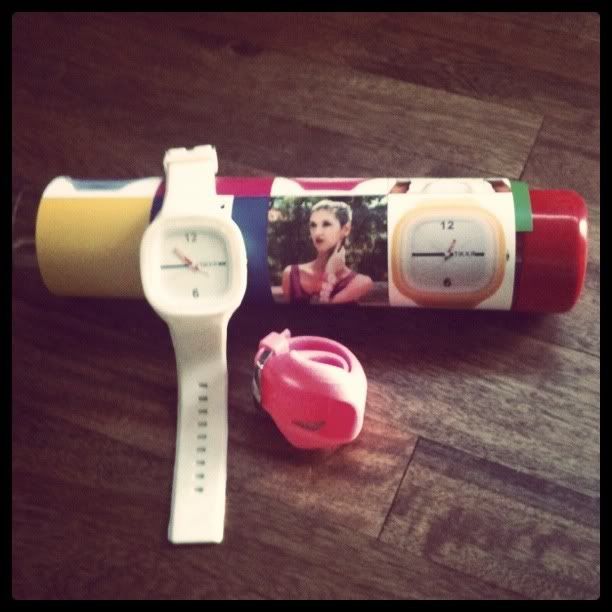
      June Giveaway - Win a TIKKR watch and extra band!

      One of the highlights of attending the Texas Style Council Conference back in March was the amazing TIKKR watch given to all attendees. I absolutely love mine, and wanted to share my love with you!

      The winner of this giveaway will receive a TIKKR watch with both a white and a pink band!


      To enter, simply do the following:
      • Follow my blog through Google Friend Connect;
      • and leave a comment at the end of this post with your email address! Comments left without a valid email will not be counted as entries.
      • For an *extra* entry, follow me on Twitter @dresscourage and tweet the following about the giveaway: I just entered the TIKKR watch giveaway from @dresscourage! http://tinyurl.com/3qvjetk 
      Good luck! The winner will be chosen on June 25th!

      Tuesday, May 31, 2011

      Outfit Post: The tyranny of the "bikini body"

      Memorial Day weekend, 1981: I am seven years old. My parents are hosting a barbecue and have invited my grandparents, aunts and uncles, cousins, and neighborhood friends. The air smells like roasting barbecue briquettes, daylilies, freshly cut grass and hot dogs.The rhythmic spurt-spurt-spurt of the sprinkler permeates the air. I am wearing an enticing two-piece yellow terry cloth bikini which ties around my neck, and my cousins and I shriek as we run through the needle-sharp spray of the sprinkler. My waist-long hair drips water down my back. I feel happy, unencumbered and free.

      Flash forward to Memorial Day weekend, present day: I am 36 years old. My husband and three children chatter excitedly about going to the neighborhood pool. I have zero desire to go to the pool, because going to the pool means wearing my swimsuit in public. I stand in front of my dresser and try to calm myself down. I try on two-piece after two-piece, self-esteem plummeting in the process. Swimsuits lie tangled on the floor. My thighs seem to expand with each selection. My body takes up too much space. I am flabby and fat and all-together unacceptable. I feel like a failure.

      Every summer, I go through the exact same ritual. I become obsessively focused on the notion of the perfect bikini body, an entity I am certain every woman possesses except for myself. The NY Times recently ran an article exploring the notion of the bikini body, examining the effect it has on fear-inspired marketing campaigns and as a symbol of physical perfection.

      There's no way of figuring out when the phrase "bikini body" was first uttered or when its tyranny took hold. It's common knowledge that the two-piece as we know it was invented in 1946 by engineer Louis Réard who christened it after Bikini Atoll. The style became popular in the 50's and by the 80's was standard beachwear. As our culture increasingly enshrines physical perfection, the bikini has come to inspire dread and awe. It wasn’t always so. In the 1960s, when bellybutton-baring suits first became popular in America, “it was a youthful phenomenon definitely,” said Sarah Kennedy, the author of “The Swimsuit: A History of Twentieth-Century Fashions.” Then the high-fashion set and movie stars began to put on bikinis, and by the ’70s, she said, the bikini was “worn by all ages.”

      And a few extra pounds didn’t disqualify anyone, considering the fitness revolution was still roughly a decade away. (The NY Times mentions that in the book there’s a 1940s photograph of a fresh-faced still-brunet Marilyn Monroe looking smashing in a two-piece, a roll of pale flesh at her midsection.)

      Writes The Guardian's Laurie Penny:

      When it finally became popular in the 1960s, the bikini was a symbol of physical liberation, of beautiful women reacting to the stern sexual prudery of previous decades by exposing as much skin to the sun as they pleased. Today, as with many iterations of the sexual emancipation rhetoric of the 1960s, wearing a bikini is no longer associated with pleasure and daring, but with anxiety, dieting rituals and joyless physical performance...The bikini body has become cultural shorthand for a moral standard of female perfection whereby any physical flaw should be regarded as a source of shame, an obstacle to collective fantasies of glamour and happiness.
      When did  the bikini become the standard of all beauty? I'm going to theorize that the first Sports Illustrated swimsuit issues, published in 1964, had a lot to do with it. With that publication, swimsuits became explicitly linked with the standards of female desirability. Also, the Swimsuit Issue is published in the winter and had little to do with the reality of actual women being at the beach, let alone swimming, and a lot to do with unattainable goals.

      "Bikini body" is the going code for "acceptable." It is always in bikinis that the tabloids feature the "best" and "worst" bodies. Type "bikini body" into Google and you get the following suggested searches:

      bikini body workout
      bikini body diet
      bikini body tips
      bikini body fast
      quick bikini body

      The bikini body has nothing to do with overall health, or fitness, or lifestyle. No, it's about shedding "winter weight" fast, before some arbitrary deadline known as "Bikini Season," at which point we're forced to confront a two-piece suit with, naturally, the requisite "bikini wax," and no trace of cold-weather pastyness. Jezebel argues that the "bikini body" craze goes so much deeper than fatism or fatphobia. It is part of our society's relentless insistence that a woman's body is not her own. It is an object to be criticized.  Our society seems to think that a woman wears a bikini not for herself, but for the public to decide her worthiness.

      Will the world end tomorrow if I can't cram my butt into a bikini? I was going to ask Stephen Hawking, but, after some careful mathematical calculations, I was able to come up with the answer on my own: No. Does this mean that I still don't have days where I hate my thighs and stomach so much I want to carve them off of my body with a fillet knife? No. But I understand that those days will happen and that they really don't matter because there truly is NOTHING wrong with my body. I've put it through a lot in the past 36 years and it's stuck around and carried me through everything.

      So my motto is this: Just be healthy. Eat things that are nutritionally good for you and exercise, but don't forget about delicious, delicious baked goods and gelato from Pacuigo. Don't deprive yourself of things to satisfy the warped and nonsensical views of people that see you as another bottomless pocket and empty head. 

      Do what you want, eat what you want, wear what you want, and be who you want.


      Now I ask you: How you deal with the pressure of the "bikini body?" Does wearing a swimsuit in public make you break out in a sweat? Do you avoid going to the beach, pool or lake because of this fear? Does wearing a swimsuit cause you to dread summer activities? And do you have a favorite swimsuit that makes you feel great about yourself?

      Thrifted Gap chambray shirt: thrifted vintage dress; Old Navy belt; White Mountain sandals; TIKKR watch; Charming Charlie bracelet; Forever 21 necklace


      Monday, May 23, 2011

      Outfit Post: The labels we wear on the inside

      This past Saturday night I went to see the Black Angels with Erin of Work With What You've Got. It was loud, and hot, and the audience was at capacity with bearded and ponytailed twenty-something hipsters in black concert tees, skinny jeans and Chucks. The venue smelled like beer and pot and cigarettes and a million other unidentifiable odors. I wore a fetching ensemble composed of a Forever 21 hot-pink leopard sports bra under a lace trapeze top, paired with a thrifted vintage black skirt and black leather platform sandals. With my tattoos and bright red hair, I thought I blended in pretty well, despite the fifteen year-age difference between me and the rest of the crowd. After five hours of talking and singing and yelling and dancing and people-watching, I eventually crawled home after one o'clock in the morning. All in all, it was a fantastic night.

      However, on Sunday morning I was in serious pain. I couldn't hear out of my left ear. My throat was raw. My head ached something fierce. And my feet were sore from hours spent in those platforms (which I wore despite warnings from my husband that they'd make me a cripple before the night was over. Okay, husband, you were right. There, I said it.) I spent most of the day popping Advil and lying on the couch curled in a fetal position.

      In the wake of my post-concert trauma, I started to question whether I should have attended the event in the first place. I wondered about the condition of the other concert-goers the next morning. Were they suffering from pounding headaches and sore throats? Did their feet hurt? And the came the inevitable questions: Was I too old to have been there? Did I look ridiculous? Were my days of late nights behind me? Did I belong at home, watching depressing sitcoms on CBS and clipping coupons for things like Sunsweet prunes?

      While pondering these questions, I was reminded of a recent post on Psychology Today about the internal labels we carry. The author explored the life-long struggle many of us have to shake off the limits we think define us. Often these labels have been internalized for years, and the fight against them can feel like a never-ending challenge.

      Reading this article led to some fairly deep introspection. I mentally flipped through ways I label myself.

      "You're too old to stay up until all hours."
      "You're too fat to wear those skinny jeans."
      "You can't shop in that store."
      "You're not talented enough to be a writer."
      "You can't make a long road trip by yourself."
      "You're not stylish/cool/youthful enough to wear that outfit."
      "You're not fit enough to run a 10k."
      "You shouldn't leave the house without make-up."

      Labels have a way of sticking around. Often they've been adopted following a traumatic event or conversation with an important person in your life. My mother was a strict enforcer of rules, and I grew up believing that there were certain things I just couldn't do because they were inappropriate, unbecoming or unladylike. That included wearing certain types of clothes, staying out late, or even going places alone. Growing up with such strict limits also discouraged me from even trying to challenge them - why have hope when I'm just going to fail? The defeatist, pessimistic nature of labels keeps us confined and crippled by self-doubt and insecurity. Criticism from a boss, close friend, or teacher can also reinforce the ways we label ourselves. Sometimes it only takes the slightest reminder to trigger our biggest fears and doubts.

      Thankfully, I'm determined to challenge the ways I label myself. Despite the fears that I was going to look redonk, I wore that neon leopard bra. I danced and sang at the top of my lungs and stayed out late. And I had a fantastic time. My morning after guilt is inevitable after challenging myself, but it's no excuse for me to continue to abide by labels.

      Do you believe that you have internalized labels that limit yourself from being who you are? What are some ways you label yourself? Are there things you believe you just can't or shouldn't do? What do you do to challenge these labels?

      Thrifted Target tuxedo jacket; Forever 21 lace tank; Forever 21 sports bra; thrifted vintage skirt; White Mountain sandals; thrifted vintage Coach satchel; TIKKR watch; Forever 21 rhinestone bracelets


      Tuesday, May 17, 2011

      Outfit Post: In which I wear a miniskirt, and commit a hideous fashion crime.

      I am wearing a miniskirt today. I'm warning you at the beginning of this post in order to give you a moment to avert your eyes, and introduce the following: If you're over 35, a recent survey out of Britain reveals that no one wants to see you in a miniskirt. Period.

      Yesterday my attention was directed towards a delightfully insane little survey regarding age-appropriate dressing, recently published in the Daily Mail (or the Daily Fail, as I prefer to call it.) If the results are to be believed, women over the age of 35 are committing fashion suicide if caught wearing a miniskirt. Quell horror! The study polled 2,000 women age 18 to 65 and found that "mini-skirts are a 'no-no' on anyone aged 35 or more," along with a slew of other cutoff dates, like no bikinis over 47 (unless you're Helen Mirren - when you look like this in a two-piece, you can do whatever the heck you please), no high heels over 51, and no leggings after 45. I might also mention that a similar study was covered by the Daily Mail back in 2007, though that study concurred that women over 28 are the perpetrators of fashion crimes. Apparently we've progressed a bit since then.

      Caron Leckie, a nutritionist for Diet Chef (some sort of prepared-meals diet site, which sponsored the survey) told the Daily Mail, "It's up to individuals to choose when they should stop wearing certain items...Saying that, everyone wants to look the best they can and now is the prime time to get in shape for summer." Ugh. *eye roll* Leave it to a diet company to conduct a poll that has no other purpose than to make women feel worse about themselves.

      Here's the full list of specific article of attire along with corresponding cut-off age:

      * Bikini: 47
      * Mini skirt: 35
      * Stilettos: 51
      * Belly button piercing: 35
      * Knee high boots: 47
      * Trainers: 44
      * Leather trousers: 34
      * Leggings: 45
      * Ugg boots: 45
      * Swimsuit: 61
      * Tight vest: 44
      * See-through chiffon blouse: 40
      * Long hair: 53
      * Ponytail: 51

      Good lord. I audibly recoil at the mere thought of arbitrary rules restricting how women choose to dress and present themselves to the world. It's my belief that surveys like these play into the notion that women should cover up once they hit a certain number, as if a 34-year-old can rock a miniskirt like nobody's business, only to turn into a hideous freak the day she turns 35. They state nothing about the value individual choice plays into fashion; how a woman decides which silhouettes are flattering to her shape; and how fashion makes you feel.

      Furthermore, these types of surveys reinforce the notion that women must have a mantra when deciding how to get dressed. The "no white after labor Day; no bared arms after forty" rules serve to limit and remind us that there are things we just shouldn't do. Women generations before us internalized these rules and bought clothes to abide by them. Dressing by the rules might have been an integral part of societal norms, but women may have missed out on wearing something they truly loved as a result.

      Helen Mirren's famous bikini photos, and 47 year-old model Kristen McNemany's recent swimsuit shoot, demonstrate that the only thing that should influence a woman's choice in fashion is her self-esteem.
      When it comes to "age appropriate" clothing, perhaps it's not so much about numbers as it is about one's own confidence and ability to pull off trends and styles without looking like they are trying to be anything but themselves. This subject is so tricky that I actually tackled it before in a post back in March, though that was a more generalized discussion about dressing to stay young and not about avoiding specific articles of clothing. The Sartorialist blogger Scott Schuman once stated: "I don't believe in age-appropriate dressing. I believe in spirit-appropriate dressing."

      What do you think? Any cut-off age that you particularly agree or disagree with? At what age will you stop wearing a miniskirt? Do you ever feel like your age prevents you from wearing something you want to? Discuss!


      (Have you entered my giveaway for a gift bag and new bronzing products from The Body Shop? Enter here!)


      Forever 21 striped tee; Anthropologie skirt; Gap sandals; TIKKR watch; Charming Charlie's rings


      Saturday, April 9, 2011

      Outfit post: The care and feeding of a redhead

      Let me share a wee little secret: I am not a natural redhead. (SHOCKING, I realize. And, in other news, water is wet.) My natural hair color falls somewhere between dishwater brown and Betty White's. I started going gray around my senior year of high school, when my heartthrob crush (we'll call him Marc) loudly and rather emphatically drew my attention to a thick gray hair peeking out from my angled bob. I was mortified, and spent the remainder of my high school career hiding from him and begging my mom for permission to color my hair.

      My adventures as a redhead began in 1994, when I plunked down $7 of babysitting money for a box of Nice and Easy haircolor in natural light auburn. Yes, there were numerous mishaps in those early days of at-home hair color: stained fingers; a month of purplish-burgundy hair after accidentally leaving the color on longer than instructed; dye drips down the back of my neck; and an unfortunate attempt at coloring my eyebrows. I could describe these in further detail, but I prefer to leave them in the past. Because they're mortifying.

      Eventually I got the hang of at-home color, and began to look forward to the nights I colored my hair. And I learned a few things about being a redhead:
       

      • As a redhead, men will like you. A lot. Probably because they fall victim to the cultural myth that redheads are fiery and saucy and highly sexed. Jonathon Swift satirized (and popularized) this redhead stereotype back in 1726, in the third chapter of Gulliver's Travels, when he wrote: "It is observed that the red-haired of both sexes are more libidinous and mischievous than the rest, whom yet they much exceed in strength and activity." Over time, you'll become proficient at ignoring (or telling off) the leeches who proclaim their love for your red hair.
      • Everyone - and I mean everyone - will ask you if your hair is "natural." No matter whether your red hair is from a box or gifted from God. It's kind of like being pregnant with twins, and strangers question whether fertility drugs were the cause.
      • Red hair color fades really quickly, and you'll be forced to become an expert on shampooing and styling techniques to prevent fade. For example, I only wash my hair every other day, and rely on a color-depositing shampoo like Bumble and Bumble's Color Support Shampoo in True Red. Devotees of red hair color should avoid frequent heat styling and chlorine, and shampoo with cool water.
      • Finding the right shade of red hair color can be tricky. A very subtle red may not be noticeable in dark hair or against darker skin, while a brighter shade may stand out too much on those with fair skin. It's a good idea to try a temporary washout color treatment in the experimental stages. If you don't like the color, a few rinses in the shower should wash out the color.  

      I absolutely love being a redhead. It suits my outgoing, extroverted personality and makes me feel a bit more unique. Some say blondes have more fun, but I beg to differ. In a world where blonde is the norm (and especially here in North Dallas) vibrant red heads stand out in the crowd. 

      Would you ever consider going red? Or are you a redhead already? Do you have any tips for preventing color fade? 


      Anthropologie tank; Gap Outlet cargos; Stuart Weitzman wedges; Forever 21 necklaces; Forever 21 bracelets; TIKKR watch